
The system of linear equations \(x+y+1=0\) and \(2x+2y+7=0\) has:
Answer & explanation
Correct answer: option 4
The correct answer is Option (4) → No Solution
For a pair of linear equations \(a_1x+b_1y+c_1=0\) and \(a_2x+b_2y+c_2=0\), the ratios of the coefficients decide the number of solutions. If \(\frac{a_1}{a_2}=\frac{b_1}{b_2}\ne\frac{c_1}{c_2}\), the two lines are parallel and never meet, so there is no solution.
\(\displaystyle\frac{a_1}{a_2}=\frac{1}{2}\) and \(\displaystyle\frac{b_1}{b_2}=\frac{1}{2}\), equal
\(\displaystyle\frac{c_1}{c_2}=\frac{1}{7}\), different from \(\frac{1}{2}\), so the lines are parallel
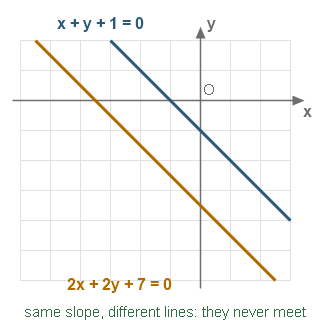
Why the other options are incorrect
Option (1) Quadratic Solution — Incorrect. Two straight lines can meet in one point, no point or every point; there is no “quadratic” kind of solution.
Option (2) Unique Solution — Incorrect. One solution needs \(\frac{a_1}{a_2}\ne\frac{b_1}{b_2}\), so that the lines cross; here these ratios are equal.
Option (3) Infinite Solution — Incorrect. Infinitely many solutions need all three ratios equal, so that both equations give the same line; here \(\frac{c_1}{c_2}\) differs.