Which substrate from the following will give the foul smell on heating with chloroform and ethanolic potassium hydroxide ?
Answer & explanation
Correct answer: option 1
The correct answer is Option (1) → Methylamine
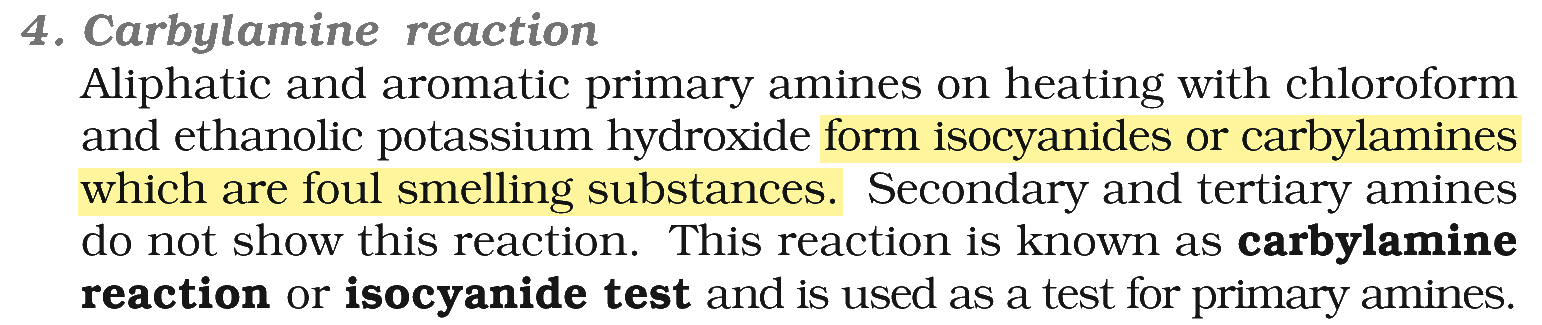
Heating an amine with chloroform and ethanolic potassium hydroxide is the carbylamine reaction (isocyanide test). Only primary amines, aliphatic or aromatic, give it. They form isocyanides (carbylamines), which have a very unpleasant, foul smell:
\( \displaystyle \ce{R-NH2 + CHCl3 + 3KOH} \xrightarrow{\text{heat}} \ce{R-NC + 3KCl + 3H2O} \)
The reaction needs two hydrogen atoms on the nitrogen, so secondary and tertiary amines do not give it.
Methylamine, \( \ce{CH3NH2} \), is a primary amine. It gives methyl isocyanide, \( \ce{CH3NC} \), with the foul smell:
\( \displaystyle \ce{CH3NH2 + CHCl3 + 3KOH} \xrightarrow{\text{heat}} \ce{CH3NC + 3KCl + 3H2O} \)
Why the other options are incorrect
Option (2) Pyridine — Incorrect. The nitrogen is part of an aromatic ring and carries no hydrogen, so it behaves like a tertiary amine and gives no isocyanide.
Option (3) N-Methylaniline — Incorrect. \( \ce{C6H5NHCH3} \) is a secondary amine, with only one H on nitrogen.
Option (4) N,N-Dimethylaniline — Incorrect. \( \ce{C6H5N(CH3)2} \) is a tertiary amine, with no H on nitrogen.
NCERT (2026-27 edition):
Carbylamine Reaction