
CUETMOCK
  • Pricing
  • Mentors
Log inStart freeStart free mocks→

First test, then trust

Try a free CUET mock test.

Join 5,00,000+ students who rehearsed exam day on the exact NTA screen before sitting CUET. On the web and on Android.

Start free mocks →Get the Android app
CUETMOCK

India's #1 CUET Mock Test Platform. Original NCERT-based questions on the exact NTA exam screen — trusted by 5,00,000+ students since CUET 2022.

Get it onGoogle PlayScan to download the CUETMOCK app

Mock tests

  • CUET mock test series
  • Commerce mocks
  • Humanities (Arts) mocks
  • Science mocks
  • Languages & GAT mocks
  • Free practice questions
  • Pricing

Resources

  • CUET exam guide
  • CUET syllabus
  • Universities accepting CUET
  • Expert blogs
  • News & notifications
  • Webinars & counselling
  • CUET score calculator
  • How we estimate your rank
  • FAQs

Company

  • About us
  • Our leadership & team
  • Our toppers
  • Mentors
  • For schools
  • Contact us
  • Terms
  • Privacy
  • Refund policy

Talk to us

+91 7696 6630 56info@cuetmock.comWhatsApp us

Our other platforms

  • JEE Mock — For IIT-JEE aspirants
  • NEET Mock — For NEET aspirants

Newsletter

Exam updates, study material and offers — no spam.

© 2026 NYC Ventures Pvt. Ltd.

701-702, Royal Business Park, Zirakpur, Punjab - 140603

  • Terms of use
  • Privacy policy
  • Refund policy
  • Contact us

iCUETMOCK is an independent preparation platform, not affiliated with the National Testing Agency (NTA). Always check exam details on the official NTA website.

  • Home
  • Mock tests
  • CUET guide
  • Pricing
  • Log in
Home/Practice questions/Biology
BiologySexual Reproduction in Flowering Plants

Identify the parts labelled A to E in the following diagram of a typi…

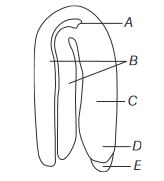
Identify the parts labelled A to E in the following diagram of a typical dicot embryo.
Answer & explanation+

Correct answer: option 1

The correct answer is Option (1) → A–Plumule, B–Cotyledons, C–Hypocotyl, D–Radicle, E–Root cap

A typical dicot embryo has an embryonal axis and two cotyledons. The part of the axis above the cotyledons is the epicotyl, which ends in the plumule at the top. The part below the cotyledons is the hypocotyl, which ends in the radicle (root tip), and the root tip is covered by a root cap.

In the diagram, A is the plumule at the tip, B points to the two cotyledons, C is the hypocotyl below them, D is the radicle and E is the root cap at the lower end.

Option (1) A–Plumule, B–Cotyledons, C–Hypocotyl, D–Radicle, E–Root cap — Correct. A–Plumule, B–Cotyledons, C–Hypocotyl, D–Radicle, E–Root cap follows the order of the parts from top to bottom.

Option (2) A–Hypocotyl, B–Cotyledons, C–Plumule, D–Radicle, E–Root cap — Incorrect. The hypocotyl lies below the cotyledons, not at the tip, so it cannot be A. The plumule is at the top.

Option (3) A–Radicle, B–Root cap, C–Plumule, D–Hypocotyl, E–Cotyledons — Incorrect. The radicle and root cap are at the lower end of the axis, so they cannot be A and B at the top.

Option (4) A–Cotyledons, B–Hypocotyl, C–Plumule, D–Root cap, E–Radicle — Incorrect. The cotyledons are the two lateral structures marked B, not A at the tip, and the root cap lies below the radicle, not above it.

Note: Five arrows on one small drawing were enough to set this question. Cover the labels of the NCERT embryo figures with your hand and see whether you can still name every part.

NCERT Extract:
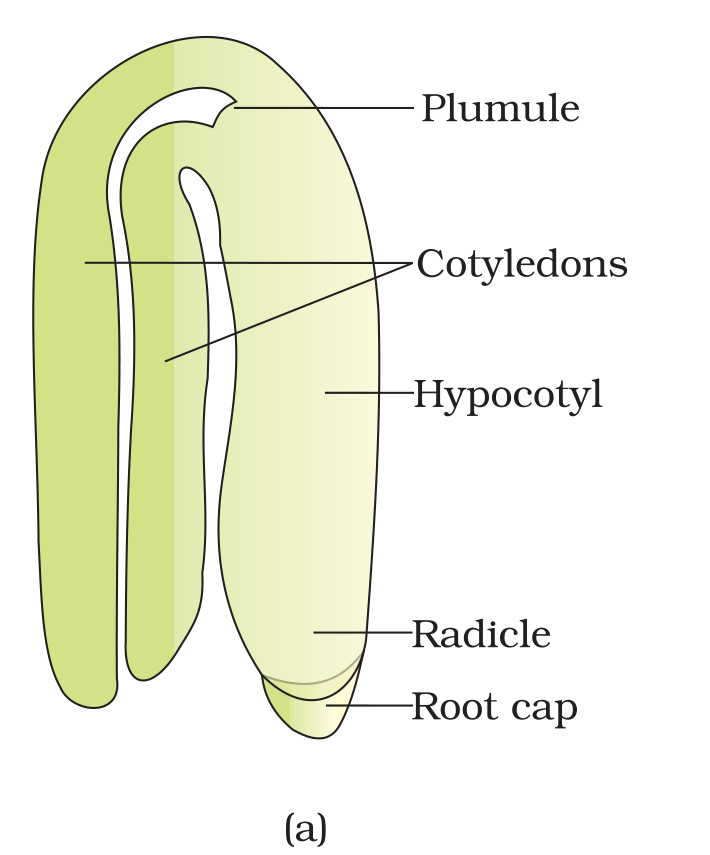
Embryo – “… A typical dicotyledonous embryo (Figure 1.14a), consists of an embryonal axis and two cotyledons. The portion of embryonal axis above the level of cotyledons is the epicotyl, which terminates with the plumule or stem tip. The cylindrical portion below the level of cotyledons is hypocotyl that terminates at its lower end in the radicle or root tip. The root tip is covered with a root cap.”
Textbook figure

Figure 1.14 (a) A typical dicot embryo

Advertisement

Practise more on Sexual Reproduction in Flowering Plants

Chapter-wise mocks on the real NTA exam screen, with solutions and your rank. Your first mocks are free.

Start free mocks →

Advertisement

Next questions

  1. Which of the following is Not an Operating Activity?Accountancy Part B · Cash Flow Statement
  2. Who won American Open Tennis Championship 2024 in Women's Singles Category?General Aptitude Test · Current Affairs
  3. Match List I with List II LIST ILIST II A.The region represented by x ≥ 0, y ≥ 0 I.no feasible region B.The region represented by the inequ…Maths. Section B1 · Linear Programming
  4. A can finish one-third of a work in 5 days, B can finish 2/5th of the same work in 10 days and C can finish 75% of the same work in 15 days…General Aptitude Test · Numerical Ability
  5. The process of initiating production in accordance with pre-conceived production plan is called as:Entrepreneurship · Entrepreneurial Planning
  6. How many times President has declared National emergency in India?General Aptitude Test · General Knowledge
  7. Physics · Electric Charges and Fields
  8. Surface area of cube of edge ‘a’ is:General Aptitude Test · Quantitative Reasoning
  9. A solid copper sphere of radius 6 cm is melted and redrawn into a wire, whose radius of cross-section is 8 cm. Find the length of the wire.General Aptitude Test · Quantitative Reasoning
  10. Select the most appropriate ANTONYM of the given word. CULPABLEEnglish · Antonyms