
CUETMOCK
  • Pricing
  • Mentors
Log inStart freeStart free mocks→

First test, then trust

Try a free CUET mock test.

Join 5,00,000+ students who rehearsed exam day on the exact NTA screen before sitting CUET. On the web and on Android.

Start free mocks →Get the Android app
CUETMOCK

India's #1 CUET Mock Test Platform. Original NCERT-based questions on the exact NTA exam screen — trusted by 5,00,000+ students since CUET 2022.

Get it onGoogle PlayScan to download the CUETMOCK app

Mock tests

  • CUET mock test series
  • Commerce mocks
  • Humanities (Arts) mocks
  • Science mocks
  • Languages & GAT mocks
  • Free practice questions
  • Pricing

Resources

  • CUET exam guide
  • CUET syllabus
  • Universities accepting CUET
  • Expert blogs
  • News & notifications
  • Webinars & counselling
  • CUET score calculator
  • How we estimate your rank
  • FAQs

Company

  • About us
  • Our leadership & team
  • Our toppers
  • Mentors
  • For schools
  • Contact us
  • Terms
  • Privacy
  • Refund policy

Talk to us

+91 7696 6630 56info@cuetmock.comWhatsApp us

Our other platforms

  • JEE Mock — For IIT-JEE aspirants
  • NEET Mock — For NEET aspirants

Newsletter

Exam updates, study material and offers — no spam.

© 2026 NYC Ventures Pvt. Ltd.

701-702, Royal Business Park, Zirakpur, Punjab - 140603

  • Terms of use
  • Privacy policy
  • Refund policy
  • Contact us

iCUETMOCK is an independent preparation platform, not affiliated with the National Testing Agency (NTA). Always check exam details on the official NTA website.

  • Home
  • Mock tests
  • CUET guide
  • Pricing
  • Log in
Home/Practice questions/Chemistry
ChemistryPhysical: Electro Chemistry

The figure shows how the molar conductivity (Λm) of aqueous solutions…

The figure shows how the molar conductivity (Λm) of aqueous solutions of CH3COOH and of KCl changes with c1/2.
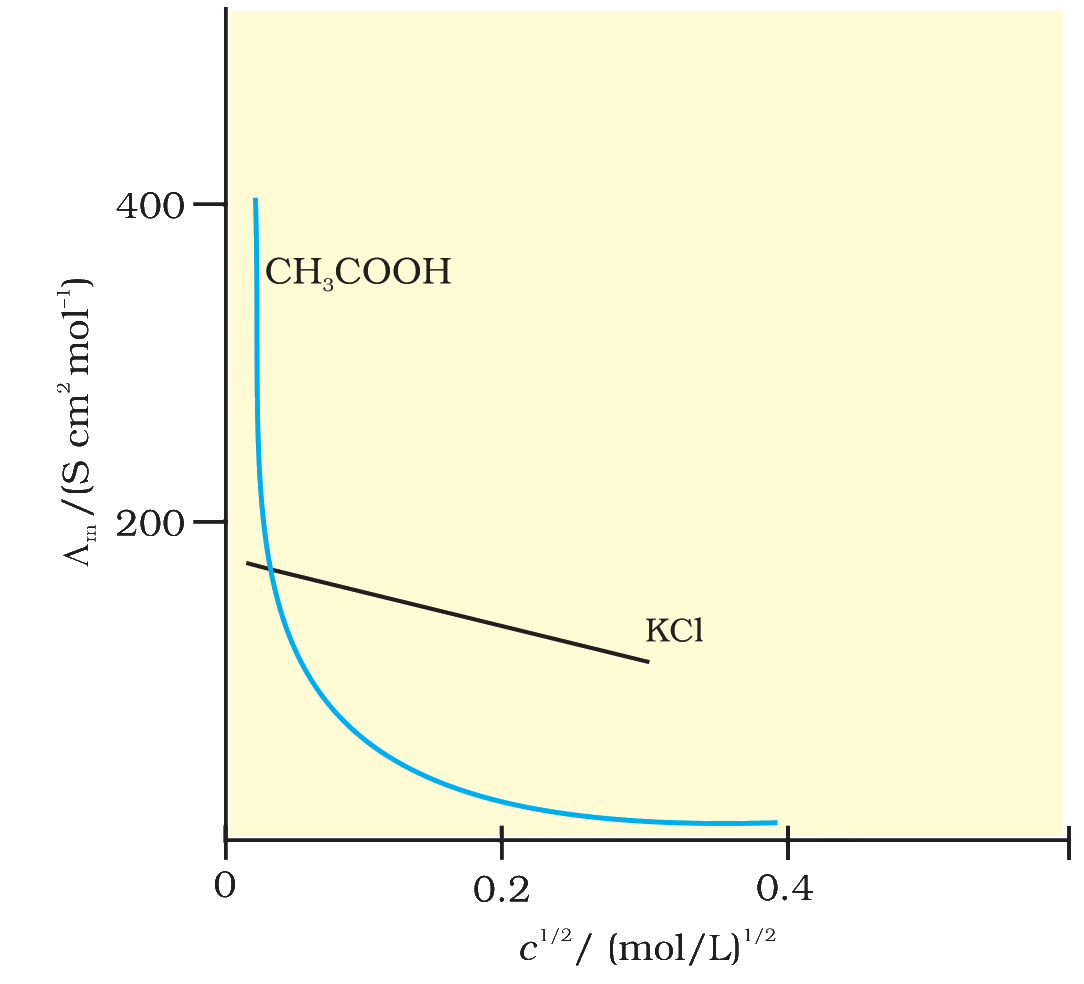
Molar conductivity versus c1/2 for CH3COOH and KCl

For which of the two compounds can the limiting molar conductivity (Λ°m) be obtained by extending its plot to zero concentration, and why?

Answer & explanation+

Correct answer: option 4

The correct answer is Option (4) → KCl, because its plot is a straight line that can be extended to c1/2 = 0

Λ°m is the molar conductivity when the concentration approaches zero, so it can be read from a plot only when the plot can be extended to c1/2 = 0.

  • KCl (a strong electrolyte) gives a straight line: its Λm increases slowly with dilution. The line is extended to c1/2 = 0, and its intercept gives Λ°m.

        \( \Lambda_m = \Lambda_m^{\circ} - A\,c^{1/2} \)

  • CH3COOH (a weak electrolyte) gives a curve that rises steeply near low concentrations, as its degree of dissociation increases on dilution. This curve cannot be extended to zero concentration, so its Λ°m is found by Kohlrausch law instead.

Why the other options are incorrect

Option (1) CH3COOH, because its Λm reaches the highest values near zero concentration — Incorrect. The high values come from the steep rise near zero concentration, and this steep rise is the reason the curve cannot be extrapolated.

Option (2) Both CH3COOH and KCl, because Λm of both increases on dilution — Incorrect. Λm of both increases on dilution, but only the KCl plot is a straight line that can be extended; the CH3COOH curve cannot.

Option (3) Neither of them, because Λm of both changes with concentration — Incorrect. A change with concentration does not prevent extrapolation: Λm of KCl changes in a straight line with c1/2, and the intercept of this line gives Λ°m.

NCERT (2026-27 edition):
Strong Electrolytes – “For strong electrolytes, Λm increases slowly with dilution and can be represented by the equation:”

    \( \displaystyle \Lambda_m = \Lambda_m^{\circ} - A\,c^{1/2} \qquad (2.23) \)

“It can be seen that if we plot (Fig. 2.6) Λm against c1/2, we obtain a straight line with intercept equal to Λ°m and slope equal to ‘–A’.”

Weak Electrolytes – “Weak electrolytes like acetic acid have lower degree of dissociation at higher concentrations… In such cases Λm increases steeply (Fig. 2.6) on dilution, especially near lower concentrations. Therefore, Λ°m cannot be obtained by extrapolation of Λm to zero concentration.”

Fig. 2.6

Fig. 2.6: Molar conductivity versus c½ for acetic acid (weak electrolyte) and potassium chloride (strong electrolyte) in aqueous solutions.

Advertisement

Practise more on Physical: Electro Chemistry

Chapter-wise mocks on the real NTA exam screen, with solutions and your rank. Your first mocks are free.

Start free mocks →

Advertisement

Next questions

  1. Grok 3, a highly advanced AI chatbot, is developed by ______.General Aptitude Test · Current Affairs
  2. Match the books in List - I with the authors in List - II. LIST-I(Books)LIST-II(Authors)(A)Caste today(I)M.N. Srinivas(B)Caste: It’s Modern…Sociology · Indian Society: Patterns of Social Inequality and Exclusion
  3. An electrochemical cell is made by connecting Nickel and Chromium electrodes. With the help of information given below, the correct value o…Chemistry · Physical: Electro Chemistry
  4. Select the figure from among the given options that can replace the question mark(?) in the following series.General Aptitude Test · Verbal Reasoning
  5. For the function f(x) = 2x^3 - 9x^2 + 12x - 5,\ x ∈ [0, 3] , match List-I with List-II: List-IList-II (A)Absolute maximum value(I)3 (B)Abso…Maths. Section A · Applications of Derivatives
  6. A researcher is interested in estimating the population of India in 2050 and is developing mathematical models to forecast changes in age c…Sociology · Indian Society: Demographic Structure of Indian Society
  7. A ray of light strikes an air-glass interface at an angle of incidence of 60^° and is refracted at an angle of refraction r. On increasing…Physics · Ray Optics
  8. In the following question, out of the given four alternatives, select the alternative which best expresses the meaning of the Idiom/Phrase.…English · Grammar: Idioms
  9. Who are the ‘bahujans’?Political Science · Politics in India Since Independence: Recent Developments in Indian Politics
  10. An aqueous solution containing Na+, Sn2+, Cl– and SO42– ions, all at unit concentration, is electrolyzed between a silver anode and a plati…Chemistry · Physical: Electro Chemistry