Which of the following statements is incorrect?
Answer & explanation
Correct answer: option 2
The correct answer is Option (2) → The sum of Average propensity to save and marginal propensity to save is always equal to one.
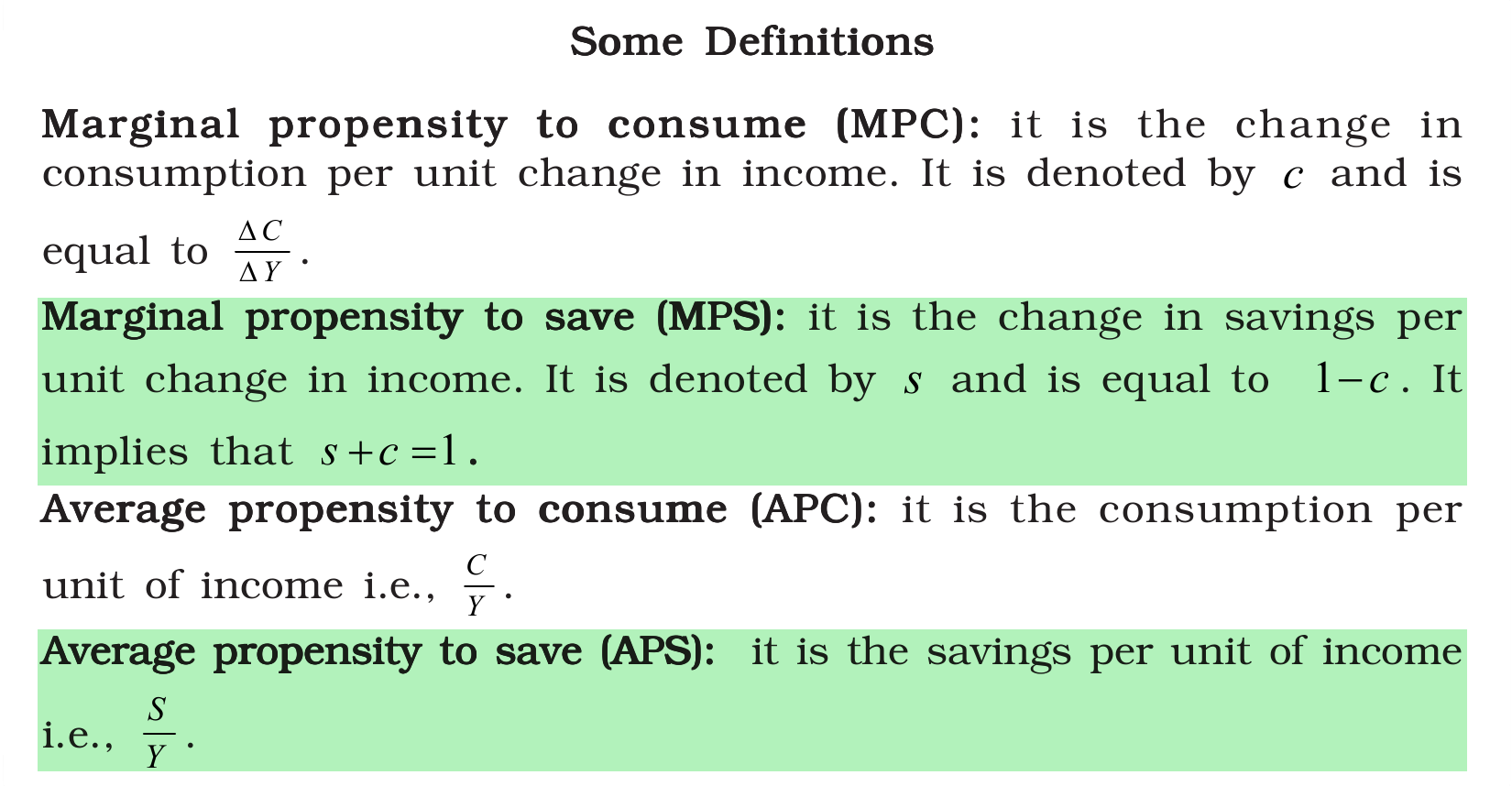
Income is either consumed or saved. So average propensity to consume (APC) + average propensity to save (APS) add up to one. Marginal propensity to consume (MPC) + marginal propensity to save (MPS) also add up to one. APS and MPS do not form such a pair.
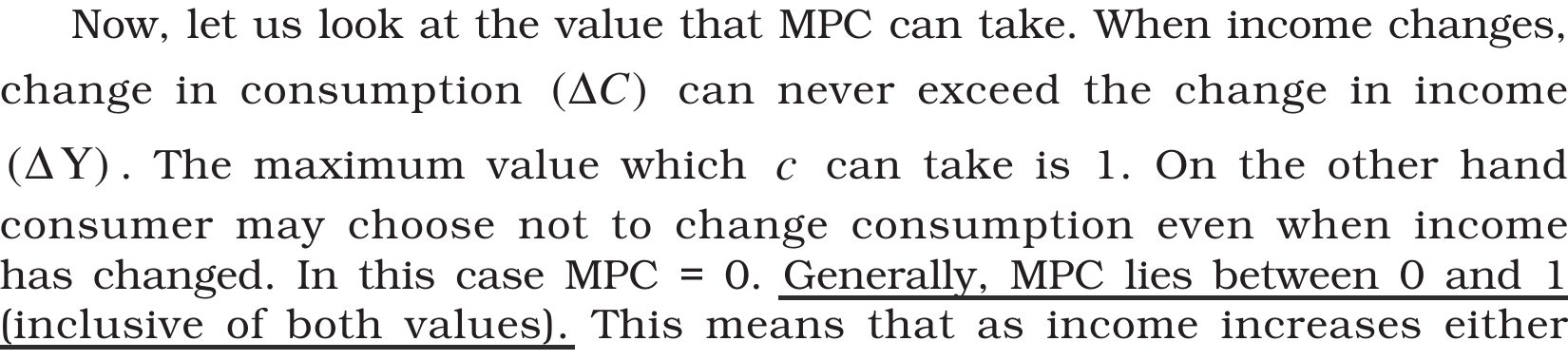
Option (1) Value of Marginal propensity to save ranges from 0 to 1 — True. MPS is 1 − MPC, and MPC lies between 0 and 1.
Option (2) The sum of Average propensity to save and marginal propensity to save is always equal to one. — False. For example, take C = 100 + 0.75Y at Y = 800. Then S = 100, so APS = 0.125, while MPS = 0.25. Their sum is 0.375.
Option (3) At the break-even-point of the economy, income and consumption are equal. — True. At this point all income is consumed, so saving is zero.
Option (4) Value of average propensity to save rises with increase in income. — True. The consumption that does not depend on income (autonomous consumption) stays the same, so it takes a smaller share of a larger income. APC falls and APS rises.
NCERT (2026-27): Introductory Macroeconomics — Chapter 4: Determination of Income and Employment
|