CUETMOCK
  • Pricing
  • Mentors
Log inStart freeStart free mocks→

First test, then trust

Try a free CUET mock test.

Join 5,00,000+ students who rehearsed exam day on the exact NTA screen before sitting CUET. On the web and on Android.

Start free mocks →Get the Android app
CUETMOCK

India's #1 CUET Mock Test Platform. Original NCERT-based questions on the exact NTA exam screen — trusted by 5,00,000+ students since CUET 2022.

Get it onGoogle PlayScan to download the CUETMOCK app

Mock tests

  • CUET mock test series
  • Browse all papers
  • Commerce mocks
  • Humanities (Arts) mocks
  • Science mocks
  • Languages & GAT mocks
  • Free practice questions
  • Pricing

Resources

  • CUET exam guide
  • CUET syllabus
  • Universities accepting CUET
  • Expert blogs
  • News & notifications
  • Webinars & counselling
  • CUET score calculator
  • How we estimate your rank
  • FAQs

Company

  • About us
  • Our leadership & team
  • Our toppers
  • Mentors
  • For schools
  • Contact us
  • Terms
  • Privacy
  • Refund policy

Talk to us

+91 7696 6630 56info@cuetmock.comWhatsApp us

Our other platforms

  • JEE Mock — For IIT-JEE aspirants
  • NEET Mock — For NEET aspirants

Newsletter

Exam updates, study material and offers — no spam.

© 2026 NYC Ventures Pvt. Ltd.

701-702, Royal Business Park, Zirakpur, Punjab - 140603

  • Terms of use
  • Privacy policy
  • Refund policy
  • Contact us

iCUETMOCK is an independent preparation platform, not affiliated with the National Testing Agency (NTA). Always check exam details on the official NTA website.

  • Home
  • Mock tests
  • CUET guide
  • Pricing
  • Log in
Home/Practice questions/Economics
EconomicsMicro Economics: Market Equilibrium

Which of the following statement/statements are true? Statement I: Wh…

Which of the following statement/statements are true?

Statement I: When increase in demand is less than increase in supply, equilibrium price falls.

Statement II: When increase in demand is less than increase in supply, equilibrium quantity increases.

Answer & explanation+

Correct answer: option 1

The correct answer is Option (1) → Both Statements are true

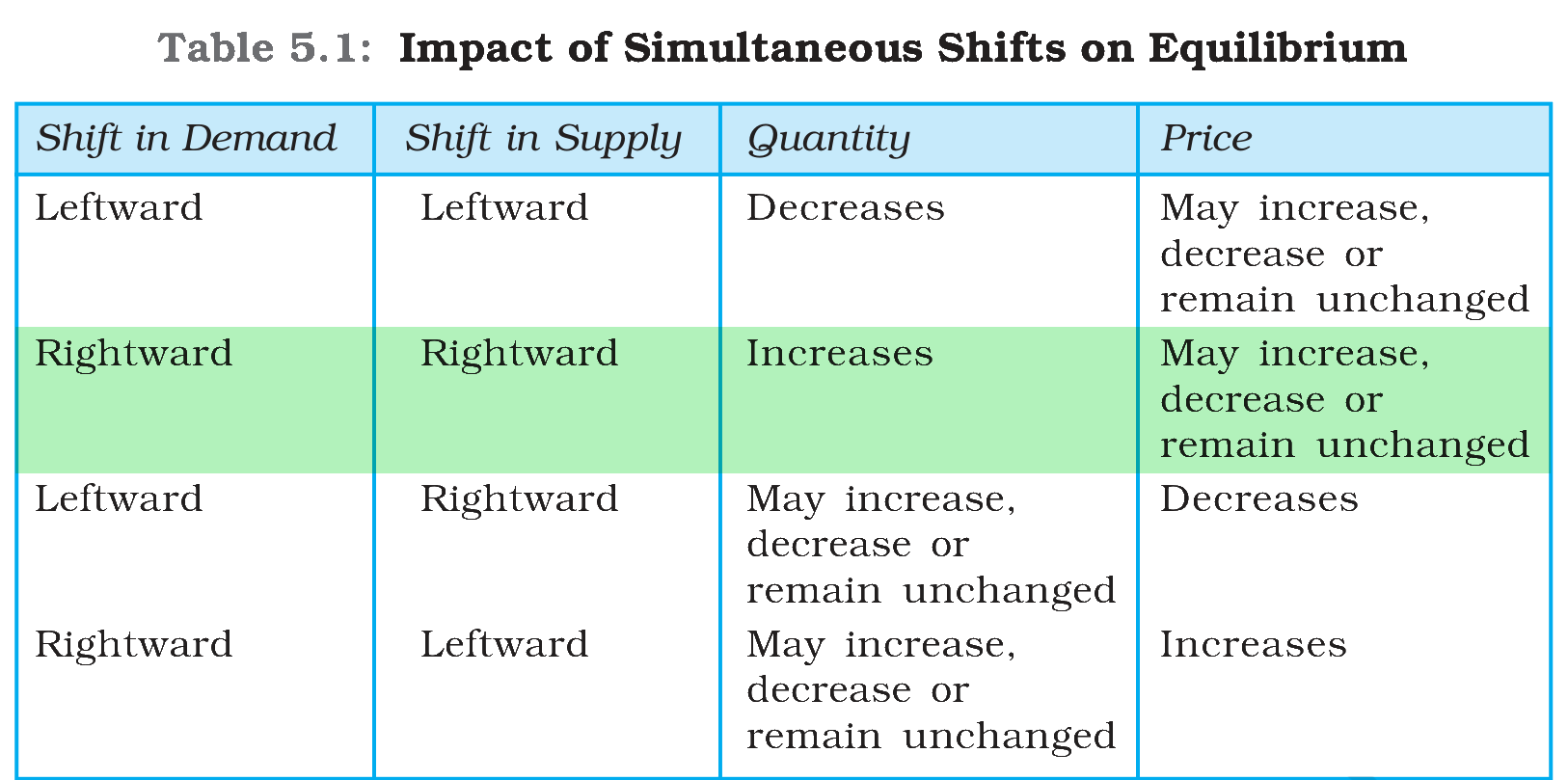
An increase in demand and an increase in supply are both rightward shifts. The quantity surely rises; the price depends on which shift is larger.

Statement I: When increase in demand is less than increase in supply, equilibrium price falls. — True. When supply rises by more, the downward push on price is stronger than the upward pull, so the price falls.

Statement II: When increase in demand is less than increase in supply, equilibrium quantity increases. — True. Both shifts add to the quantity, so the quantity increases whatever their sizes.

NCERT (2026-27): “Simultaneous Shifts of Demand and Supply … The impact on equilibrium price and quantity in all the four cases are given in Table 5.1. Each row of the table describes the direction in which the equilibrium price and quantity will change for each possible combination of the simultaneous shifts in demand and supply curves. For instance, from the second row of the table, we see that due to a rightward shift in both demand and supply curves, the equilibrium quantity increases invariably but the equilibrium price may either increase, decrease or remain unchanged. The actual direction in which the price will change will depend on the magnitude of the shifts. … In the first two cases which are shown in the first two rows of the table, the impact on equilibrium quantity is unambiguous but the equilibrium price may change, if at all, in either direction depending on the magnitudes of shifts. In the next two cases, shown in the last two rows of the table, the effect on price is unambiguous whereas effect on quantity depends on the magnitude of shifts in the two curves.”

NCERT extract

Advertisement

Practise more on Micro Economics: Market Equilibrium

Chapter-wise mocks on the real NTA exam screen, with solutions and your rank. Your first mocks are free.

Start free mocks →

Advertisement

Next questions

  1. Which of the following was declared a royal monopoly by the Ahom kings of Assam?History · Medieval India: Peasants, Zamindars and the State
  2. Where did Humayun take refuge after being dethroned by Sher Khan?Fine Arts · The Mughal School of Miniature Painting
  3. Match List I with List II LIST ILIST II A. Index number for the base yearI. Paasche's index number B. P_01 = (Σ p_1q_0)/(Σ p_0q_0) × 100 II…Applied Maths. Section B2 · Time Based Data
  4. What is the formula of urea ?Chemistry · Physical: Solutions
  5. Who was the Deputy Prime Minister of India between 1967-1969?Political Science · Politics in India Since Independence: Crisis of democratic Order
  6. What is the nature of histone proteins?Biology · Molecular Basis of Inheritance
  7. Select the most appropriate synonym of the given word. XENIALEnglish · Synonyms
  8. Select the odd group of numbers. (NOTE: Operations should be performed on the whole numbers, without breaking down the numbers into its con…General Aptitude Test · General Ability
  9. Which one of the following is responsible for producing the large holes in "Swiss cheese"?Biology · Microbes in Human Welfare
  10. 'Hampi' derived its name from ______.History · Medieval India: An Imperial Capital: Vijayanagara