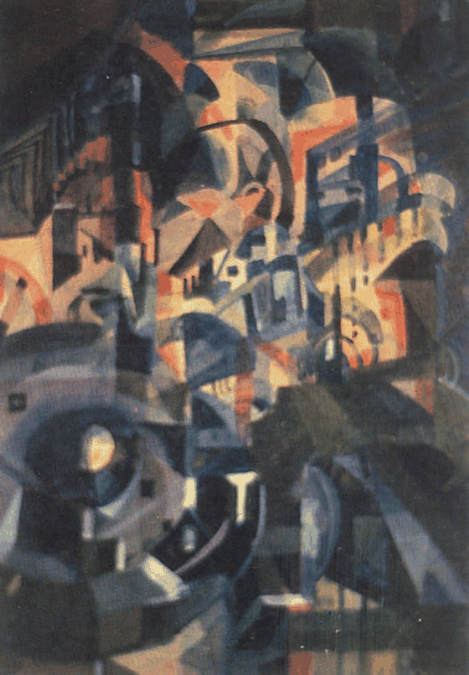
Observe the image and answer the following question.
Its painter visualised the mysterious world of his imaginary cities like Dwarka (Lord Krishna’s legendary abode) or Swarnapuri (The Golden City). Through which of the following did he render them?
Answer & explanation
Correct answer: option 1
The correct answer is Option (1) → Multiple viewpoints, multi-faceted shapes and jagged edges of Cubism
The painting is City in the Night by Gaganendranath Tagore.
Option (1) Multiple viewpoints, multi-faceted shapes and jagged edges of Cubism — Correct. He was one of the earlier Indian painters to use the language of Cubism, and he painted his imaginary cities in its manner.
Option (2) Soft, misty and impressionistic effects of the wash technique — Incorrect. The wash technique gives this soft, misty effect in Abanindranath Tagore’s Journey’s End. It is not how these cities were painted.
Option (3) Calligraphic line typical in Mughal manuscripts and old Persian paintings — Incorrect. This calligraphic line marks the wash paintings of Abdul Rehman Chughtai, such as Radhika. It is not how these cities were painted.
Option (4) Flat and colourful style of folk painting seen in villages — Incorrect. Jamini Roy adopted this folk style after rejecting his academic training. It is not how these cities were painted.
NCERT (2026-27): “City in the Night This is a watercolour painting made by Gaganendranath Tagore (1869 –1938) in 1922. He was one of the earlier Indian painters, who made use of language and syntax of Cubism to render his ideas. … He softened Cubism’s formal geometry with a seductive profile, shadow or outline of human form. He visualised the mysterious world of his imaginary cities like Dwarka (Lord Krishna’s legendary abode) or Swarnapuri (The Golden City) through multiple viewpoints, multi-faceted shapes and jagged edges of Cubism.”
|