Match List-I with List-II
| List-I | List-II |
| Physical Quantity | Dimensional Formula |
| (A) Capacitance | (I) \( [\mathrm{M\,L^{3}\,T^{-3}\,A^{-1}}] \) |
| (B) Electric Flux | (II) \( [\mathrm{M\,L^{2}\,T^{-3}\,A^{-1}}] \) |
| (C) Potential | (III) \( [\mathrm{L^{-2}\,A\,T}] \) |
| (D) Polarisation | (IV) \( [\mathrm{M^{-1}\,L^{-2}\,T^{4}\,A^{2}}] \) |
Choose the correct answer from the options given below:
Answer & explanation
Correct answer: option 1
The correct answer is Option (1) → (A) - (IV), (B) - (I), (C) - (II), (D) - (III)
Start from the dimensions of charge \( [\mathrm{A\,T}] \) and of potential (work per unit charge), and build the others from their defining relations.
(C) Potential — this matches (II) \( [\mathrm{M\,L^{2}\,T^{-3}\,A^{-1}}] \). Potential is work per unit charge.
\( \displaystyle [V] = \frac{[W]}{[q]} = \frac{[\mathrm{M\,L^{2}\,T^{-2}}]}{[\mathrm{A\,T}]} = [\mathrm{M\,L^{2}\,T^{-3}\,A^{-1}}] \)
(A) Capacitance — this matches (IV) \( [\mathrm{M^{-1}\,L^{-2}\,T^{4}\,A^{2}}] \). Capacitance is charge per unit potential.
\( \displaystyle [C] = \frac{[q]}{[V]} = \frac{[\mathrm{A\,T}]}{[\mathrm{M\,L^{2}\,T^{-3}\,A^{-1}}]} = [\mathrm{M^{-1}\,L^{-2}\,T^{4}\,A^{2}}] \)
(B) Electric Flux — this matches (I) \( [\mathrm{M\,L^{3}\,T^{-3}\,A^{-1}}] \). Electric flux is field times area, and the field is potential per unit length.
\( \displaystyle [\Phi_E] = [E][\mathrm{L^{2}}] = [\mathrm{M\,L\,T^{-3}\,A^{-1}}][\mathrm{L^{2}}] = [\mathrm{M\,L^{3}\,T^{-3}\,A^{-1}}] \)
(D) Polarisation — this matches (III) \( [\mathrm{L^{-2}\,A\,T}] \). Polarisation is the dipole moment per unit volume.
\( \displaystyle [P] = \frac{[q][\mathrm{L}]}{[\mathrm{L^{3}}]} = [\mathrm{L^{-2}\,A\,T}] \)
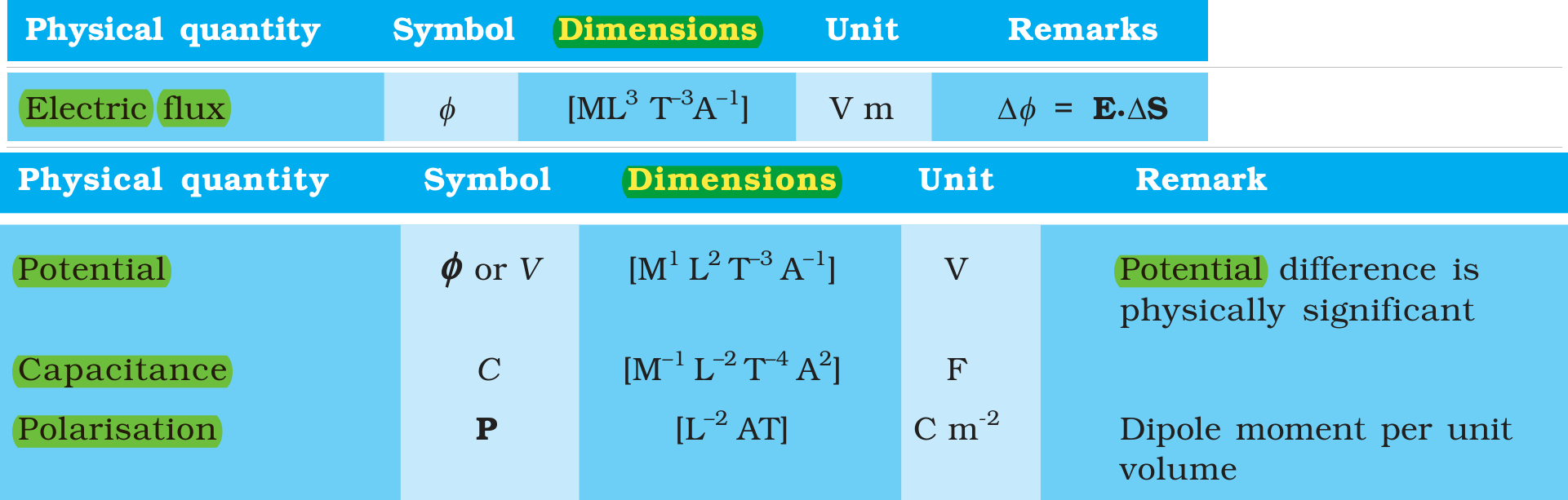
Note: The textbook table below prints the dimensions of capacitance with \( \mathrm{T^{-4}} \); this is a misprint for \( \mathrm{T^{4}} \), as \( [C] = [q]/[V] \) above shows.
NCERT (2026-27):
Summary – …