CUETMOCK
  • Pricing
  • Mentors
Log inStart freeStart free mocks→

First test, then trust

Try a free CUET mock test.

Join 5,00,000+ students who rehearsed exam day on the exact NTA screen before sitting CUET. On the web and on Android.

Start free mocks →Get the Android app
CUETMOCK

India's #1 CUET Mock Test Platform. Original NCERT-based questions on the exact NTA exam screen — trusted by 5,00,000+ students since CUET 2022.

Get it onGoogle PlayScan to download the CUETMOCK app

Mock tests

  • CUET mock test series
  • Browse all papers
  • Commerce mocks
  • Humanities (Arts) mocks
  • Science mocks
  • Languages & GAT mocks
  • Free practice questions
  • Pricing

Resources

  • CUET exam guide
  • CUET syllabus
  • Universities accepting CUET
  • Expert blogs
  • News & notifications
  • Webinars & counselling
  • CUET score calculator
  • How we estimate your rank
  • FAQs

Company

  • About us
  • Our leadership & team
  • Our toppers
  • Mentors
  • For schools
  • Contact us
  • Terms
  • Privacy
  • Refund policy

Talk to us

+91 7696 6630 56info@cuetmock.comWhatsApp us

Our other platforms

  • JEE Mock — For IIT-JEE aspirants
  • NEET Mock — For NEET aspirants

Newsletter

Exam updates, study material and offers — no spam.

© 2026 NYC Ventures Pvt. Ltd.

701-702, Royal Business Park, Zirakpur, Punjab - 140603

  • Terms of use
  • Privacy policy
  • Refund policy
  • Contact us

iCUETMOCK is an independent preparation platform, not affiliated with the National Testing Agency (NTA). Always check exam details on the official NTA website.

  • Home
  • Mock tests
  • CUET guide
  • Pricing
  • Log in
Home/Practice questions/History
HistoryAncient India: Kinship, Caste and Class

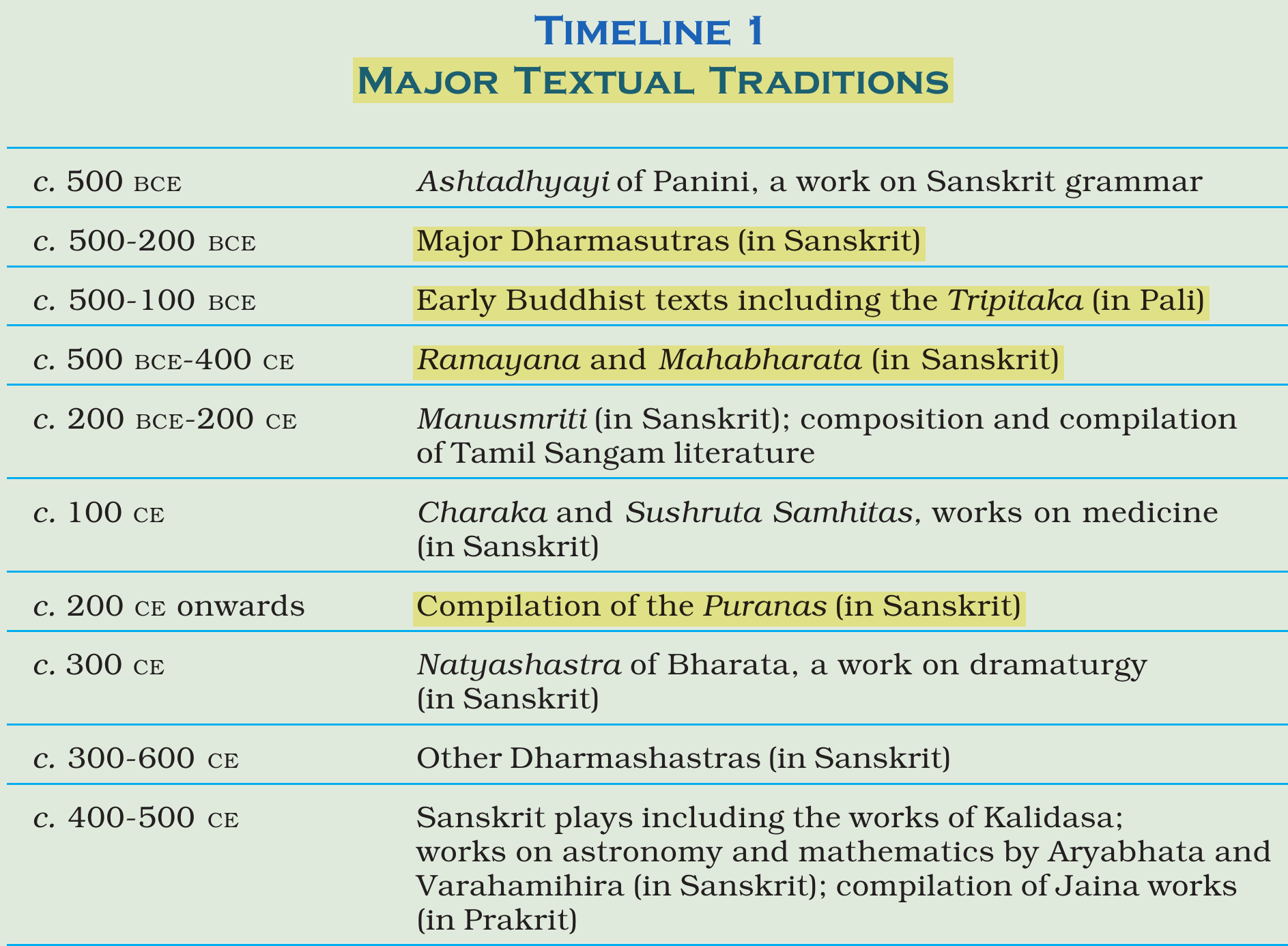
Match List I with List II:List IList II(A) 500 BCE - 400 CE(I) Major…

Match List I with List II:

List IList II
(A) 500 BCE - 400 CE(I) Major Dharmasutra (in Sanskrit)
(B) 500 - 200 BCE(II) Ramayana and Mahabharata (in Sanskrit)
(C) 200 CE onward(III) Early Buddhist text including the Tripitaka (in Pali)
(D) 500 - 100 BCE(IV) Compilation of Puranas (in Sanskrit)

Choose the correct answer from the options given below:

Answer & explanation+

Correct answer: option 4

The correct answer is Option (4) → (A)-(II), (B)-(I), (C)-(IV), (D)-(III)

(A) 500 BCE - 400 CE — this matches (II) Ramayana and Mahabharata (in Sanskrit). The two epics were composed over the long span of c. 500 BCE-400 CE.

(B) 500 - 200 BCE — this matches (I) Major Dharmasutra (in Sanskrit). The major Dharmasutras are dated c. 500-200 BCE.

(C) 200 CE onward — this matches (IV) Compilation of Puranas (in Sanskrit). The Puranas were compiled from c. 200 CE onwards.

(D) 500 - 100 BCE — this matches (III) Early Buddhist text including the Tripitaka (in Pali). The early Buddhist texts in Pali are dated c. 500-100 BCE.


NCERT: Themes in Indian History Part I — Chapter 3: Kinship, Caste and Class (2026-27)

NCERT extract

Advertisement

Practise more on Ancient India: Kinship, Caste and Class

Chapter-wise mocks on the real NTA exam screen, with solutions and your rank. Your first mocks are free.

Start free mocks →

Advertisement

Next questions

  1. सूची-I का मिलान सूची-II से कीजिए: सूची-I (वाक्य) सूची-II (मुहावरा / लोकोक्ति) A. कल रात थाने में चोरी हो गई है, सच है ______ है। I. तिल का…Hindi · व्याकरण - मुहावरे
  2. The pie-chart shows the annual car production (percentage wise) of six countries A, B, C, D, E and F. Study the pie chart and answer the qu…General Aptitude Test · Quantitative Reasoning
  3. By c. 1800 BCE most of the Mature Harappan sites had been abandoned in regions such as ______.History · Ancient India: Bricks, Beads and Bones
  4. The interval in which the function f(x) = 2x^3 + 9x^2 + 12x - 1 is decreasing is:Maths. Section B1 · Applications of Derivatives
  5. Consider the following statements about Harappan burials:(A) Some graves contain pottery and ornaments.(B) Jewellery has been found in buri…History · Ancient India: Bricks, Beads and Bones
  6. Which of the following was a contribution of Abanindranath Tagore to Indian art?Fine Arts · The Bengal School and Cultural Nationalism
  7. The ratio, in which the yz-plane divides the line joining (2, 4, 5) and (3, 5, 7), isMaths. Section B1 · Three-dimensional Geometry
  8. What is the approximate length of the navigable inland waterways of India?General Aptitude Test · General Knowledge
  9. Arrange the following rights under the Constitution of India in the order of the article they appear in Indian Constitution. A. Right to Co…Legal Studies · Human Rights in India
  10. If a=2 b=8 c and a+b+c=13 then the value of (√(a^2+b^2+c^2))/(2 c) is:General Aptitude Test · Quantitative Reasoning