CUETMOCK
  • Pricing
  • Mentors
Log inStart freeStart free mocks→

First test, then trust

Try a free CUET mock test.

Join 5,00,000+ students who rehearsed exam day on the exact NTA screen before sitting CUET. On the web and on Android.

Start free mocks →Get the Android app
CUETMOCK

India's #1 CUET Mock Test Platform. Original NCERT-based questions on the exact NTA exam screen — trusted by 5,00,000+ students since CUET 2022.

Get it onGoogle PlayScan to download the CUETMOCK app

Mock tests

  • CUET mock test series
  • Browse all papers
  • Commerce mocks
  • Humanities (Arts) mocks
  • Science mocks
  • Languages & GAT mocks
  • Free practice questions
  • Pricing

Resources

  • CUET exam guide
  • CUET syllabus
  • Universities accepting CUET
  • Expert blogs
  • News & notifications
  • Webinars & counselling
  • CUET score calculator
  • How we estimate your rank
  • FAQs

Company

  • About us
  • Our leadership & team
  • Our toppers
  • Mentors
  • For schools
  • Contact us
  • Terms
  • Privacy
  • Refund policy

Talk to us

+91 7696 6630 56info@cuetmock.comWhatsApp us

Our other platforms

  • JEE Mock — For IIT-JEE aspirants
  • NEET Mock — For NEET aspirants

Newsletter

Exam updates, study material and offers — no spam.

© 2026 NYC Ventures Pvt. Ltd.

701-702, Royal Business Park, Zirakpur, Punjab - 140603

  • Terms of use
  • Privacy policy
  • Refund policy
  • Contact us

iCUETMOCK is an independent preparation platform, not affiliated with the National Testing Agency (NTA). Always check exam details on the official NTA website.

  • Home
  • Mock tests
  • CUET guide
  • Pricing
  • Log in
Home/Practice questions/Physics
PhysicsCommunication

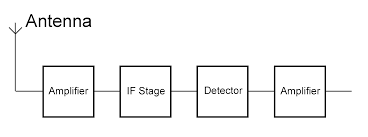
A block diagram of a typical receiver in a communication system is as…

A block diagram of a typical receiver in a communication system is as shown in figure. The various components in correct sequence is:

A. Detector

B. Amplifier 1

C. IF stage

D. Amplifier 2

E. Receiving Antenna

Choose the correct answer from the options given below:

Answer & explanation+

Correct answer: option 2

Advertisement

Practise more on Communication

Chapter-wise mocks on the real NTA exam screen, with solutions and your rank. Your first mocks are free.

Start free mocks →

Advertisement

Next questions

  1. 'Anirudh has to file a compensation claim for his defective car, which he bought for 10 lacs'. Identify the agency where he can file his cl…Business Studies · Consumer Protection
  2. In what time will a sum of ₹1,25,000 amount to ₹1,48,877 at 12% per annum, if interest is being compounded half yearly?General Aptitude Test · Numerical Ability
  3. Given below are four jumbled sentences. Pick the option that gives their correct order. Mount Everest is a peak in the Himalaya mountain ra…English · Arrange in Meaningful Sequence
  4. Two co-axial solenoids having number of turns per unit length 50 and 200, respectively have same length 50 cm. The area of cross-section of…Physics · Electromagnetic Induction
  5. A historian reading Jawaharlal Nehru's speech in the Constituent Assembly wants to know how far, in Nehru's view, the Assembly could go in…History · Modern India: Framing the Constitution
  6. The order and the degree of the differential equation (d^4y)/(dx^4) + ≤ft((d^2y)/(dx^2))^3 + y = e^x are respectivelyMaths. Section A · Differential Equations (Section A)
  7. Arrange the following Pahari miniature painting in chronological order. A. Krishna steels butter. B. Rama and Sita in the forest. C. Rasama…Fine Arts · The Pahari Schools of Painting
  8. Fill in the blanks in the sentences given in List-I with the correct prepositions given in List-II List-I (Sentences) List-II (Prepositions…English · Grammar: Preposition
  9. Select the option that is related to the fourth term in the same way as the first term is related to the second term and the fifth term is…General Aptitude Test · General Ability
  10. PQ and RS are two parallel chords of a circle such that PQ is 48 cm and RS is 40 cm. If the chords are on the opposite sides of the centre…General Aptitude Test · Quantitative Reasoning