
CUETMOCK
  • Pricing
  • Mentors
Log inStart freeStart free mocks→

First test, then trust

Try a free CUET mock test.

Join 5,00,000+ students who rehearsed exam day on the exact NTA screen before sitting CUET. On the web and on Android.

Start free mocks →Get the Android app
CUETMOCK

India's #1 CUET Mock Test Platform. Original NCERT-based questions on the exact NTA exam screen — trusted by 5,00,000+ students since CUET 2022.

Get it onGoogle PlayScan to download the CUETMOCK app

Mock tests

  • CUET mock test series
  • Commerce mocks
  • Humanities (Arts) mocks
  • Science mocks
  • Languages & GAT mocks
  • Free practice questions
  • Pricing

Resources

  • CUET exam guide
  • CUET syllabus
  • Universities accepting CUET
  • Expert blogs
  • News & notifications
  • Webinars & counselling
  • CUET score calculator
  • How we estimate your rank
  • FAQs

Company

  • About us
  • Our leadership & team
  • Our toppers
  • Mentors
  • For schools
  • Contact us
  • Terms
  • Privacy
  • Refund policy

Talk to us

+91 7696 6630 56info@cuetmock.comWhatsApp us

Our other platforms

  • JEE Mock — For IIT-JEE aspirants
  • NEET Mock — For NEET aspirants

Newsletter

Exam updates, study material and offers — no spam.

© 2026 NYC Ventures Pvt. Ltd.

701-702, Royal Business Park, Zirakpur, Punjab - 140603

  • Terms of use
  • Privacy policy
  • Refund policy
  • Contact us

iCUETMOCK is an independent preparation platform, not affiliated with the National Testing Agency (NTA). Always check exam details on the official NTA website.

  • Home
  • Mock tests
  • CUET guide
  • Pricing
  • Log in
Home/Practice questions/Physics
PhysicsNuclei

In the core of a star, fusion can build up heavier and heavier nuclei…

In the core of a star, fusion can build up heavier and heavier nuclei, for example carbon from helium. Nuclei much heavier than iron, however, cannot be produced in this way. This is because

Answer & explanation+

Correct answer: option 1

The correct answer is Option (1) → fusion into nuclei beyond the peak of the binding energy per nucleon curve does not release energy

Fusion releases energy only when the nucleus formed is more tightly bound. That is, its binding energy per nucleon must be greater than that of the nuclei that fuse. On the binding energy curve this quantity rises for light nuclei and reaches its peak near iron (\( A=56 \)). It then falls slowly for heavier nuclei.

Option (1) fusion into nuclei beyond the peak of the binding energy per nucleon curve does not release energy — Correct. A nucleus beyond the peak is less tightly bound per nucleon than the nuclei that would form it. So such a fusion absorbs energy instead of releasing it.

Option (2) the nuclear force does not act between nucleons in nuclei heavier than iron — Incorrect. The nuclear force binds the nucleons of every nucleus. Heavy nuclei such as uranium are held together by the same force.

Option (3) the core temperature of a star cannot rise above about \( 10^{8}\,\mathrm{K} \) — Incorrect. About \( 10^{8}\,\mathrm{K} \) is only the stage at which helium fuses into carbon. Later stages of collapse heat the core further and build heavier nuclei. So temperature is not what stops the process at iron.

Option (4) all the hydrogen in the core is used up before such nuclei can be formed — Incorrect. The core hydrogen runs out even before helium fuses into carbon. Yet heavier nuclei still form after that. The loss of hydrogen is what makes the core collapse and heat up for these later stages.

NCERT (2026-27):
Nuclear Fusion – Energy Generation in Stars – “When two light nuclei fuse to form a larger nucleus, energy is released, since the larger nucleus is more tightly bound, as seen from the binding energy curve in Fig.13.1. …”


Nuclear Fusion – Energy Generation in Stars – “Helium is not the only element that can be synthesized in the interior of a star. As the hydrogen in the core gets depleted and becomes helium, the core starts to cool. The star begins to collapse under its own gravity which increases the temperature of the core. If this temperature increases to about 108 K, fusion takes place again, this time of helium nuclei into carbon. This kind of process can generate through fusion higher and higher mass number elements. But elements more massive than those near the peak of the binding energy curve in Fig. 13.1 cannot be so produced.”
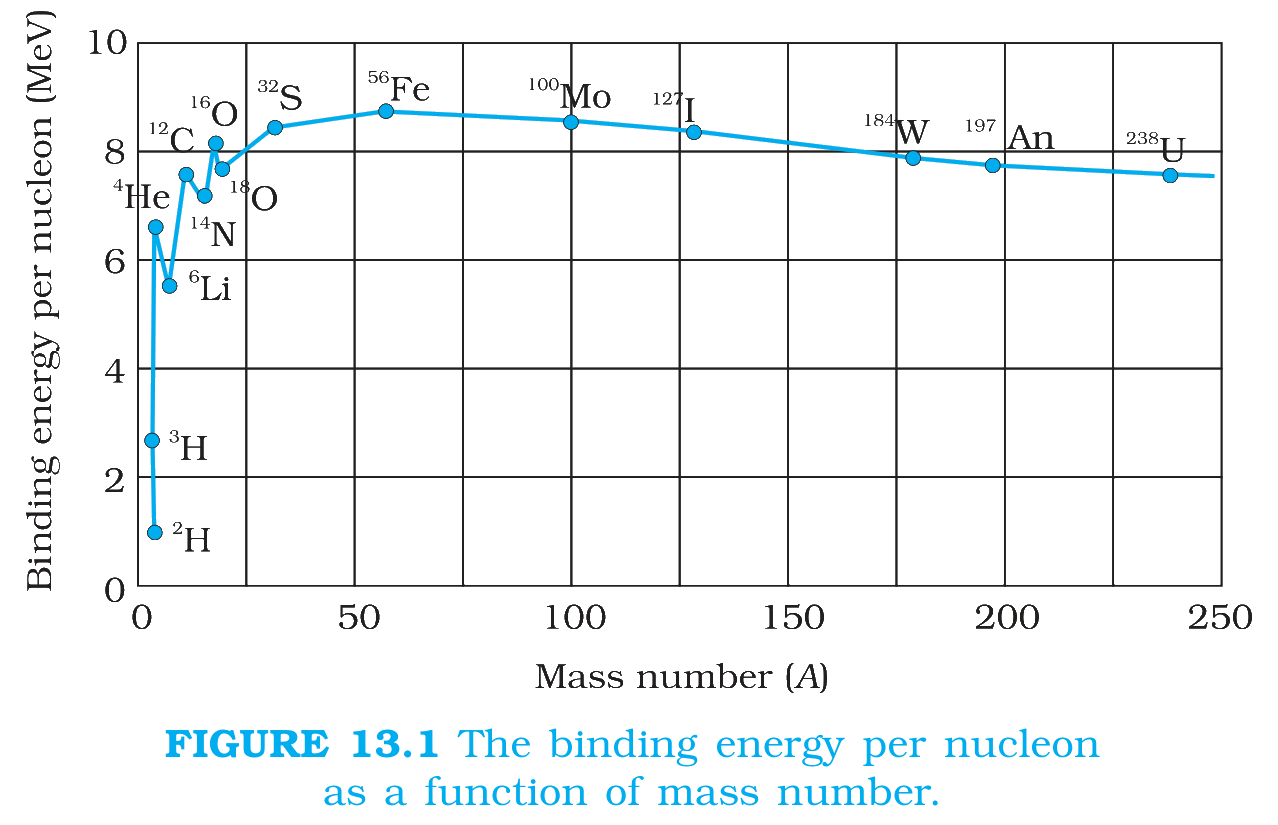
Fig. 13.1

Fig. 13.1: The binding energy per nucleon as a function of mass number.

Advertisement

Practise more on Nuclei

Chapter-wise mocks on the real NTA exam screen, with solutions and your rank. Your first mocks are free.

Start free mocks →

Advertisement

Next questions

  1. Select the option that can be used as a one-word substitute for the given group of words. Strong taste or liking for somethingEnglish · One Word
  2. Solve: (-1)/(|x|-2)≥1Maths. Section B1 · Relations and Functions
  3. During the p-n junction formation, when an electron diffuses from n → p, it leaves behind an:Physics · Semiconductors and Electronic Devices
  4. Installation became a contemporary art form in India from the 1990s. Which of the following artists were among the early installation artis…Fine Arts · The Modern Indian Art
  5. If the compound interest in the third year at 8% p.a. on certain sum is ₹3600, then what is the difference between the compound interest in…General Aptitude Test · Numerical Ability
  6. उपर्युक्त गद्यांश का उपयुक्त शीर्षक बताएँ:-Hindi · Comprehension - (Narrative / Factual)
  7. Which of the following is a feature of business environment?Business Studies · Business Environment
  8. Identify the basis on which share of Profit or Loss of deceased partner is calculated from the date of last balance sheet to the date of de…Accountancy Part A · Reconstitution of Partnership Firm: Retirement and Death
  9. What are the bad debts?Accountancy · Depreciation, Provisions and Reserves
  10. Select the combination of letters that, when placed in the blanks of the given letter series in order, will complete the series. z a _ b x…General Aptitude Test · Verbal Reasoning