Observe the given figure and answer the following questions:
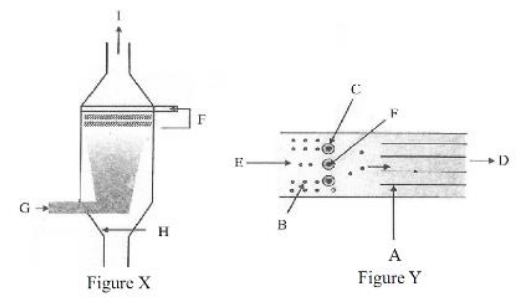
Match List – I with List – II.
| LIST I | LIST II |
| A. Discharge corona | I. B |
| B. Collection plate grounded | II. F |
| C. Water/Lime spray | III. C |
| D. Dust particles | IV. A |
Choose the correct answer from the options given below:
Answer & explanation
Correct answer: option 3
The correct answer is Option (3) → A-III, B-IV, C-II, D-I
A. Discharge corona — this matches III. C. The glow around the negatively charged wires in Figure Y.
B. Collection plate grounded — this matches IV. A. The plates that attract the charged dust.
C. Water/Lime spray — this matches II. F. The spray at the top of the scrubber in Figure X.
D. Dust particles — this matches I. B. The particles carried in with the dirty air.
Note: This question is from Chapter 16, Environmental Issues, of the pre-rationalised NCERT book. This chapter is not in the present NCERT book (2026-27). The extract below is from the pre-rationalised edition.
NCERT Extract (Pre-rationalised edition, Chapter 16, Environmental Issues):
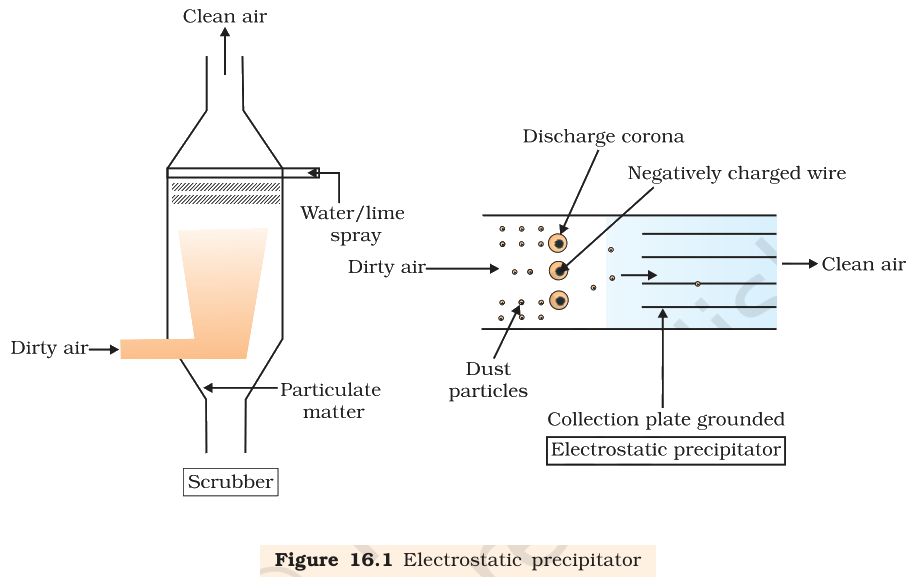
Air Pollution and Its Control – “… There are several ways of removing particulate matter; the most widely used of which is the electrostatic precipitator (Figure 16.1), which can remove over 99 per cent particulate matter present in the exhaust from a thermal power plant. It has electrode wires that are maintained at several thousand volts, which produce a corona that releases electrons. These electrons attach to dust particles giving them a net negative charge. The collecting plates are grounded and attract the charged dust particles. The velocity of air between the plates must be low enough to allow the dust to fall. A scrubber (Figure 16.1) can remove gases like sulphur dioxide. In a scrubber, the exhaust is passed through a spray of water or lime.”