How will you differentiate between a primary alcohol and a tertiary alcohol?
Answer & explanation
Correct answer: option 2
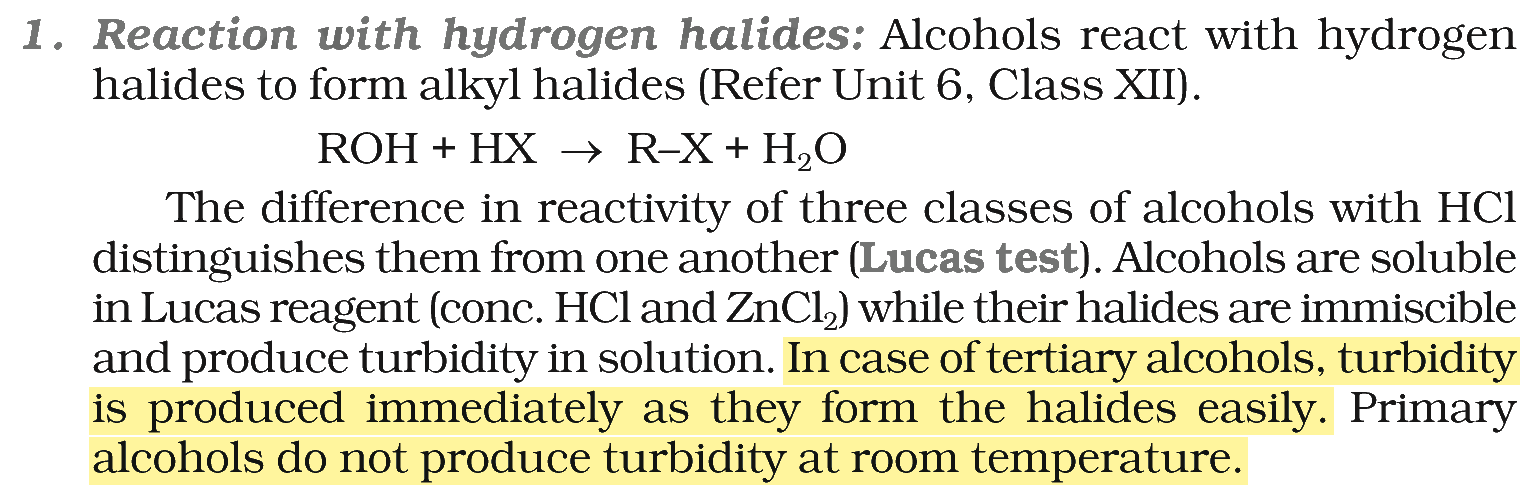
The correct answer is Option (2) → Using Lucas's reagent
With HCl and anhydrous ZnCl2, the reaction goes through a carbocation; a tertiary carbocation forms far more easily than a primary one, so the two alcohols react at very different rates:
\( \displaystyle \ce{(CH3)3C-OH + HCl} \xrightarrow{\text{anhyd. }\ce{ZnCl2}} \ce{(CH3)3C-Cl + H2O} \)
So a primary and a tertiary alcohol are distinguished by Lucas reagent.
Why the other options are incorrect
Option (1) Using phosphorus trihalide — Incorrect. \( \ce{PCl3} \) or \( \ce{PBr3} \) converts all types of alcohols into alkyl halides without a visible difference, so it cannot distinguish them.
Option (3) Using Tollens' reagent — Incorrect. Tollens’ reagent is a test for aldehydes (silver mirror); alcohols do not reduce it.
Option (4) Using wood spirit — Incorrect. Wood spirit is methanol, itself an alcohol, not a test reagent.
NCERT (2026-27 edition):
Reaction with Hydrogen Halides