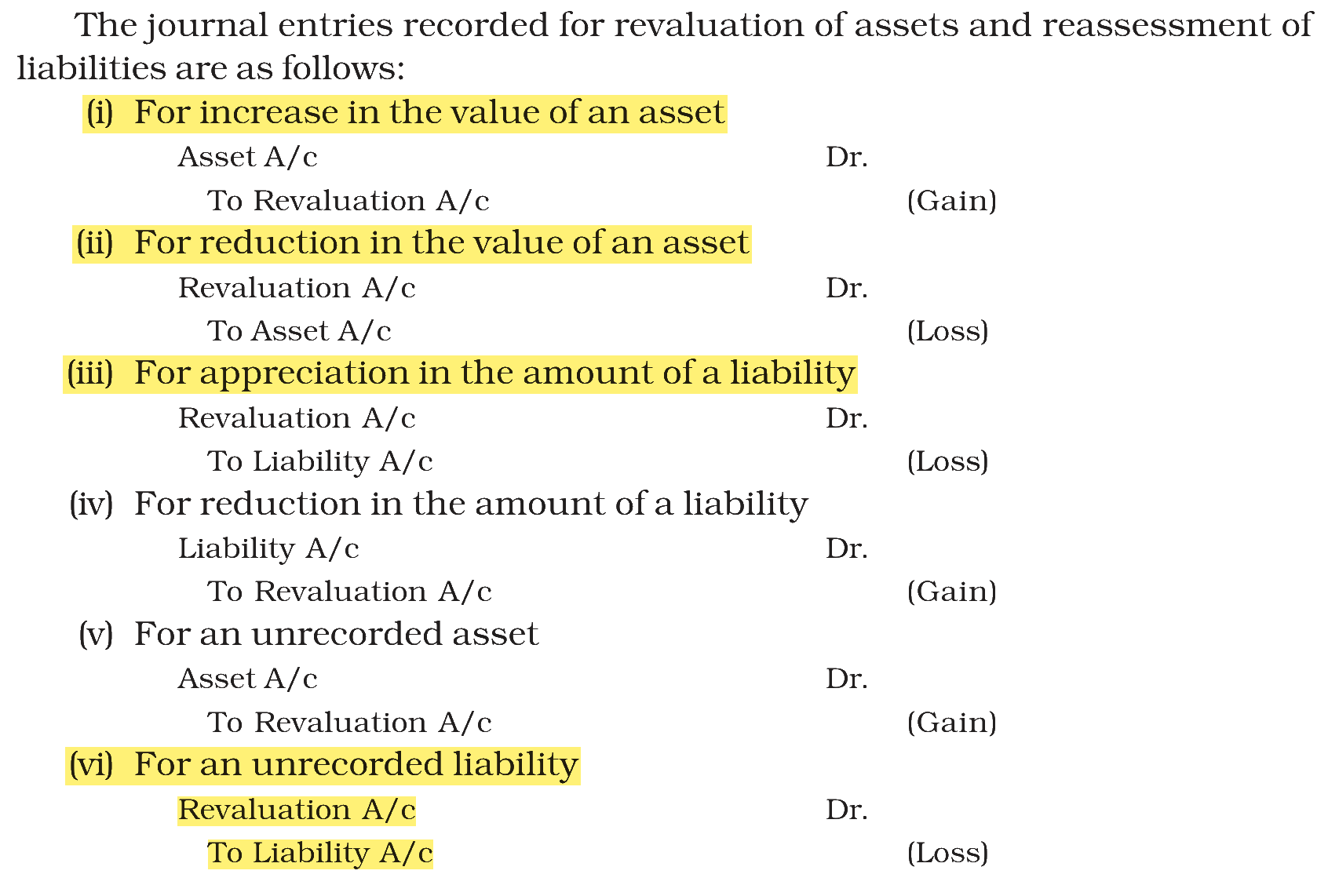
Identify the incorrect journal entry related to Revaluation of Assets and Liabilities of a firm.
Answer & explanation
Correct answer: option 4
The correct answer is Option (4) → For an unrecorded liability: Liability A/c Dr. To Revaluation A/c
The Revaluation Account collects gains and losses from revaluing assets and liabilities. A gain is credited to it and a loss debited. An unrecorded liability, once brought into the books, means the firm owes more than it showed, so it is a loss. The correct entry is:
Revaluation A/c Dr.
To Liability A/c
(Unrecorded liability brought into books)
Option (4) For an unrecorded liability: Liability A/c Dr. To Revaluation A/c — reverses it: debiting the liability would reduce it, and crediting Revaluation would show a gain.
Option (1) For increase in the value of assets: Assets A/c’s (Individually) Dr. To Revaluation A/c (Increase in the value of assets) — A correct entry. A rise in an asset is a gain, so Revaluation is credited.
Option (2) For decrease in the value of assets Revaluation A/c Dr. To Assets A/c’s (Individually) (Decrease in the value of assets) — A correct entry. A fall in an asset is a loss, so Revaluation is debited.
Option (3) For increase in the amount of liabilities Revaluation A/C Dr. To Liabilities A/c (Individually) (Increase in the amount of liabilities) — A correct entry. A higher liability is a loss, the same as an unrecorded one.
NCERT (2026-27 edition):
|