
CUETMOCK
  • Pricing
  • Mentors
Log inStart freeStart free mocks→

First test, then trust

Try a free CUET mock test.

Join 5,00,000+ students who rehearsed exam day on the exact NTA screen before sitting CUET. On the web and on Android.

Start free mocks →Get the Android app
CUETMOCK

India's #1 CUET Mock Test Platform. Original NCERT-based questions on the exact NTA exam screen — trusted by 5,00,000+ students since CUET 2022.

Get it onGoogle PlayScan to download the CUETMOCK app

Mock tests

  • CUET mock test series
  • Commerce mocks
  • Humanities (Arts) mocks
  • Science mocks
  • Languages & GAT mocks
  • Free practice questions
  • Pricing

Resources

  • CUET exam guide
  • CUET syllabus
  • Universities accepting CUET
  • Expert blogs
  • News & notifications
  • Webinars & counselling
  • CUET score calculator
  • How we estimate your rank
  • FAQs

Company

  • About us
  • Our leadership & team
  • Our toppers
  • Mentors
  • For schools
  • Contact us
  • Terms
  • Privacy
  • Refund policy

Talk to us

+91 7696 6630 56info@cuetmock.comWhatsApp us

Our other platforms

  • JEE Mock — For IIT-JEE aspirants
  • NEET Mock — For NEET aspirants

Newsletter

Exam updates, study material and offers — no spam.

© 2026 NYC Ventures Pvt. Ltd.

701-702, Royal Business Park, Zirakpur, Punjab - 140603

  • Terms of use
  • Privacy policy
  • Refund policy
  • Contact us

iCUETMOCK is an independent preparation platform, not affiliated with the National Testing Agency (NTA). Always check exam details on the official NTA website.

  • Home
  • Mock tests
  • CUET guide
  • Pricing
  • Log in
Home/Practice questions/Chemistry
ChemistryInorganic: D and F Block Elements

The hydrated copper(II) ion appears blue because it absorbs light of…

Transition metals form coloured ions or compounds due to partially filled d orbitals. In the presence of solvent molecules (in solutions), ligands (in complexes) or counter ions (in crystals), the d orbitals split into two sets. An electron in a transition metal ion that occupies the set of d orbitals of lower energy can be excited to the set of higher energy by absorbing energy from visible light. Since the energy difference (ΔE) between the two sets of d orbitals is small, only light of the visible region is absorbed during this excitation. The colour of a transition metal ion is due to this d–d excitation (d–d transition) of the electron. During d–d excitation the electron absorbs one colour of visible light, and the ion appears in the complementary colour of the absorbed light. Complementary colours can be identified from the colour wheel shown below (complementary colours lie opposite each other).
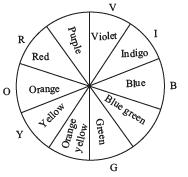
Colour wheel

The number of electrons undergoing d–d transition and the energy difference between the two sets of orbitals decide the colour.

The hydrated copper(II) ion appears blue because it absorbs light of which colour?

Answer & explanation+

Correct answer: option 3

The correct answer is Option (3) → Orange-red

  • The passage states that a transition metal ion absorbs one colour of visible light in a d–d transition and appears in the complementary colour of the light absorbed, and that complementary colours lie opposite each other on the colour wheel.

  • The hydrated copper(II) ion (3d9) appears blue. On the wheel, blue lies opposite orange, between yellow and red; of the options only orange-red lies on that side, so the ion absorbs orange-red light and transmits blue.

Why the other options are incorrect

Option (1) Green — Incorrect. Green lies opposite purple; an ion absorbing green would look purple.

Option (2) Blue — Incorrect. The colour seen is the light not absorbed; an ion absorbing blue would look orange.

Option (4) Yellow — Incorrect. On the wheel yellow lies opposite indigo, not blue.

Advertisement

Practise more on Inorganic: D and F Block Elements

Chapter-wise mocks on the real NTA exam screen, with solutions and your rank. Your first mocks are free.

Start free mocks →

Advertisement

Next questions

  1. In the following question, select the related letters from the given alternatives. SH : IT :: LM : ?General Aptitude Test · General Ability
  2. Babur defeated Mahmud Lodi and Sultan Nusrat thus establishing Mughal rule in India in the Battle of ________ in 1529.General Aptitude Test · General Knowledge
  3. Types of acquisitions includes. (A) Vertical acquisition (B) Friendly acquisition (C) Horizontal acquisition (D) Hostile acquisition (E) Co…Entrepreneurship · Entrepreneurial Opportunity
  4. The corner points of the feasible region of LPP x+y ≤ 200, y ≥ 4x, x ≥ 20, x ≥ 0, y ≥ 0 are : (A) (20, 180) (B) (40, 180) (C) (20, 80) (D)…Maths. Section B1 · Linear Programming
  5. Which five-year plan was based on the based on the ideas of Mahalanobis ?General Aptitude Test · General Knowledge
  6. Choose the correct question tag to complete the sentence:We’d better book the train tickets today, ________?English · Grammar: Question Tags
  7. Mohini purchases a house worth Rs. 50 lakhs and makes a down payment of Rs. 11.2 lakhs. She pays the remaining amount on monthly EMI using…Applied Maths. Section B2 · Financial Mathematics
  8. X and Y are partners in a firm sharing profits in the ratio of 5 : 3. They admitted Z as a new partner. The new profit sharing ratio will b…Accountancy Part A · Admission of a Partner
  9. "श्याम घर आना चाहता है" वाक्य में कौन-सी क्रिया है?Hindi · व्याकरण - क्रिया
  10. "Meluhha" in the Mesopotamian texts refers to:-History · Ancient India: Bricks, Beads and Bones