
CUETMOCK
  • Pricing
  • Mentors
Log inStart freeStart free mocks→

First test, then trust

Try a free CUET mock test.

Join 5,00,000+ students who rehearsed exam day on the exact NTA screen before sitting CUET. On the web and on Android.

Start free mocks →Get the Android app
CUETMOCK

India's #1 CUET Mock Test Platform. Original NCERT-based questions on the exact NTA exam screen — trusted by 5,00,000+ students since CUET 2022.

Get it onGoogle PlayScan to download the CUETMOCK app

Mock tests

  • CUET mock test series
  • Commerce mocks
  • Humanities (Arts) mocks
  • Science mocks
  • Languages & GAT mocks
  • Free practice questions
  • Pricing

Resources

  • CUET exam guide
  • CUET syllabus
  • Universities accepting CUET
  • Expert blogs
  • News & notifications
  • Webinars & counselling
  • CUET score calculator
  • How we estimate your rank
  • FAQs

Company

  • About us
  • Our leadership & team
  • Our toppers
  • Mentors
  • For schools
  • Contact us
  • Terms
  • Privacy
  • Refund policy

Talk to us

+91 7696 6630 56info@cuetmock.comWhatsApp us

Our other platforms

  • JEE Mock — For IIT-JEE aspirants
  • NEET Mock — For NEET aspirants

Newsletter

Exam updates, study material and offers — no spam.

© 2026 NYC Ventures Pvt. Ltd.

701-702, Royal Business Park, Zirakpur, Punjab - 140603

  • Terms of use
  • Privacy policy
  • Refund policy
  • Contact us

iCUETMOCK is an independent preparation platform, not affiliated with the National Testing Agency (NTA). Always check exam details on the official NTA website.

  • Home
  • Mock tests
  • CUET guide
  • Pricing
  • Log in
Home/Practice questions/Chemistry
ChemistryPhysical: Chemical Kinetics

The Arrhenius equation for a reaction is k = A e^-E_a/RT . Match List…

FACTORS AFFECTING RATE OF REACTION:

The rate of a chemical reaction measures how quickly reactants are consumed or products are formed. It depends on the conditions under which the reaction is carried out.

  1. Concentration: Generally, an increase in reactant concentration leads to an increase in the reaction rate. This is because a higher concentration provides more reactant particles, leading to a higher collision frequency.
  2. Temperature: The rate of reaction increases with the increase in temperature. In most cases, the rate of reaction becomes nearly double for 10° rise in temperature.
  3. Catalysts: Catalysts are substances that accelerate a reaction by providing an alternative reaction pathway with lower activation energy. They increase the rate of reaction without being consumed in the process.

The Arrhenius equation for a reaction is \( k = A\,e^{-E_a/RT} \). Match List-I with List-II.

List-IList-II
(A) Slope of the straight-line plot of ln k against 1/T(I) ln A
(B) Intercept of the straight-line plot of ln k against 1/T(II) Frequency factor
(C) The constant A(III) Activation energy, in J mol−1
(D) The term Ea(IV) \( -\frac{E_a}{R} \)

Choose the correct answer from the options given below:

Answer & explanation+

Correct answer: option 2

The correct answer is Option (2) → A-IV, B-I, C-II, D-III

Taking the natural logarithm of the Arrhenius equation gives a straight-line form, y = mx + c, with y = ln k and x = 1/T:

    \( \displaystyle \ln k = -\frac{E_a}{R}\left(\frac{1}{T}\right) + \ln A \)

(A) Slope of the straight-line plot of ln k against 1/T — This matches (IV) −Ea/R. The term multiplying 1/T is the slope; it is negative, because ln k falls as 1/T rises.

(B) Intercept of the straight-line plot of ln k against 1/T — This matches (I) ln A. The constant term of the line is its intercept on the ln k axis.

(C) The constant A — This matches (II) Frequency factor. A is the Arrhenius factor, also called the frequency factor or pre-exponential factor; it is a constant for a given reaction.

(D) The term Ea — This matches (III) Activation energy, in J mol−1. Ea is the energy barrier the reactants must cross; it is measured in joules per mole.

NCERT (2026-27 edition):
3.4 Temperature Dependence of the Rate of a Reaction – “…A is the Arrhenius factor or the frequency factor. It is also called pre-exponential factor. It is a constant specific to a particular reaction. R is gas constant and Ea is activation energy measured in joules/mole (J mol–1).”

“The plot of ln k vs 1/T gives a straight line according to the equation (3.19) as shown in Fig. 3.10.” … “In Fig. 3.10, slope = – Ea/R and intercept = ln A.”

    \( \displaystyle k = A\,e^{-E_a/RT} \qquad (3.18) \)

    \( \displaystyle \ln k = -\frac{E_a}{RT} + \ln A \qquad (3.19) \)
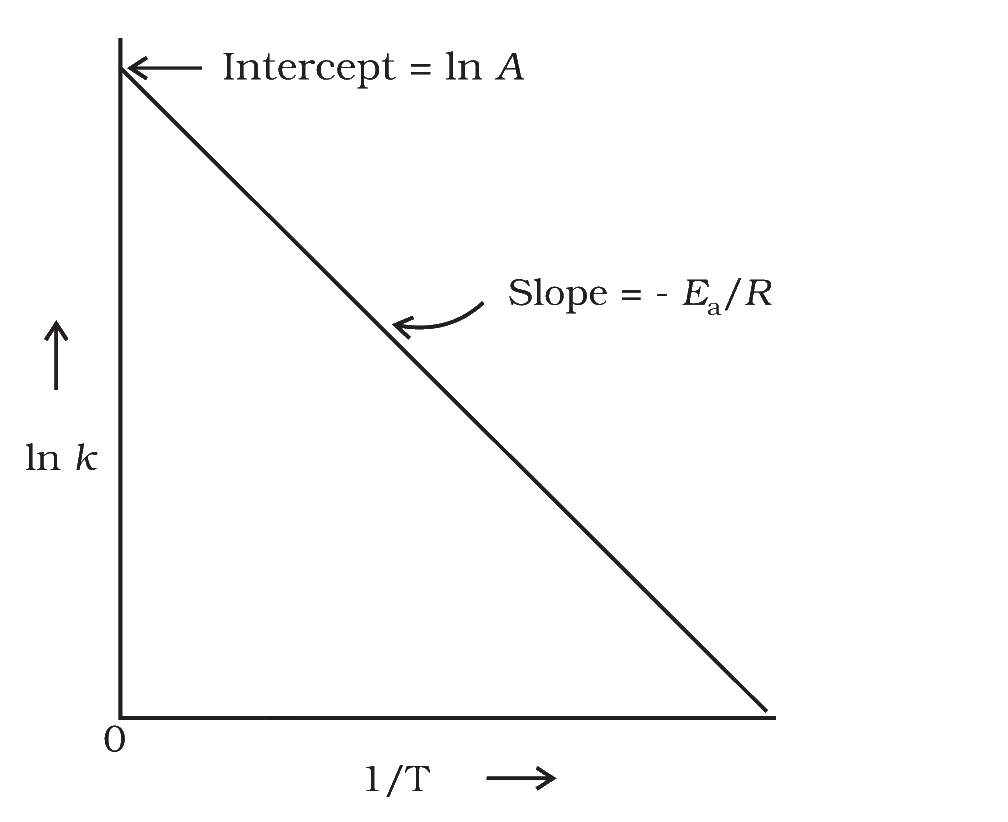
Fig. 3.10

Fig. 3.10: A plot between ln k and 1/T

Advertisement

Practise more on Physical: Chemical Kinetics

Chapter-wise mocks on the real NTA exam screen, with solutions and your rank. Your first mocks are free.

Start free mocks →

Advertisement

Next questions

  1. Match List I with List II. List I(Categories of product) List II(Examples) A. Industrial Products I. Rare collection of artwork and antique…Business Studies · Marketing
  2. Which among the following cell undergoes meiosis I during spermatogenesis?Biology · Human Reproduction
  3. Who is the author of the Kitab-ul-Hind?History · Medieval India: Through the Eyes of Travellers
  4. Which of the following is one of the metals used in LED semiconductor technology?General Aptitude Test · General Knowledge
  5. What does the figure given below show?Biology · Reproductive Health
  6. Which of the following is correct in the context of Schedule III of the Companies Act 2013?Accountancy Part B · Financial Statements of a Company
  7. The following pie-chart shows the percentage-wise distribution of the number of students in five different schools P, Q, R, S and T. Total…General Aptitude Test · Quantitative Reasoning
  8. Which among the following statement about zygotene is correct ?Biology · Cell Cycle and Cell Division
  9. RecuperateEnglish · Synonyms
  10. Select the INCORRECTLY spelt word.English · Spelling Check