
CUETMOCK
  • Pricing
  • Mentors
Log inStart freeStart free mocks→

First test, then trust

Try a free CUET mock test.

Join 5,00,000+ students who rehearsed exam day on the exact NTA screen before sitting CUET. On the web and on Android.

Start free mocks →Get the Android app
CUETMOCK

India's #1 CUET Mock Test Platform. Original NCERT-based questions on the exact NTA exam screen — trusted by 5,00,000+ students since CUET 2022.

Get it onGoogle PlayScan to download the CUETMOCK app

Mock tests

  • CUET mock test series
  • Browse all papers
  • Commerce mocks
  • Humanities (Arts) mocks
  • Science mocks
  • Languages & GAT mocks
  • Free practice questions
  • Pricing

Resources

  • CUET exam guide
  • CUET syllabus
  • Universities accepting CUET
  • Expert blogs
  • News & notifications
  • Webinars & counselling
  • CUET score calculator
  • How we estimate your rank
  • FAQs

Company

  • About us
  • Our leadership & team
  • Our toppers
  • Mentors
  • For schools
  • Contact us
  • Terms
  • Privacy
  • Refund policy

Talk to us

+91 7696 6630 56info@cuetmock.comWhatsApp us

Our other platforms

  • JEE Mock — For IIT-JEE aspirants
  • NEET Mock — For NEET aspirants

Newsletter

Exam updates, study material and offers — no spam.

© 2026 NYC Ventures Pvt. Ltd.

701-702, Royal Business Park, Zirakpur, Punjab - 140603

  • Terms of use
  • Privacy policy
  • Refund policy
  • Contact us

iCUETMOCK is an independent preparation platform, not affiliated with the National Testing Agency (NTA). Always check exam details on the official NTA website.

  • Home
  • Mock tests
  • CUET guide
  • Pricing
  • Log in
Home/Practice questions/Biology
BiologyBiotechnology -Principles and Processes

In agarose gel electrophoresis, DNA fragments are separated from one…

In agarose gel electrophoresis, DNA fragments are separated from one another on the basis of their:

Answer & explanation+

Correct answer: option 2

The correct answer is Option (2) → size

In gel electrophoresis, DNA fragments are made to move through an agarose gel by an electric field. DNA is negatively charged, so all fragments move towards the anode. The gel works like a sieve. Small fragments slip through it easily and move farther, while large fragments are held back. So the fragments end up in separate bands according to their size.

Option (1) palindromic recognition sequences — Incorrect. A palindromic recognition sequence is the site where a restriction enzyme cuts the DNA. It decides where the cuts are made, not how far a fragment moves in the gel.

Option (2) size — Correct. The agarose gel has a sieving effect. The smaller the fragment, the farther it moves, so fragments are separated by size.

Option (3) type of sticky ends — Incorrect. Sticky ends are the short single-stranded ends left by some restriction enzymes. They help in joining DNA pieces with DNA ligase, not in separating them on a gel.

Option (4) base sequence — Incorrect. Fragments of the same size move to the same place even if their base sequences differ. The gel cannot tell sequences apart.

NCERT Extract:
Separation and Isolation of DNA Fragments – “… Since DNA fragments are negatively charged molecules they can be separated by forcing them to move towards the anode under an electric field through a medium/matrix. Nowadays the most commonly used matrix is agarose which is a natural polymer extracted from sea weeds. The DNA fragments separate (resolve) according to their size through sieving effect provided by the agarose gel. Hence, the smaller the fragment size, the farther it moves.”
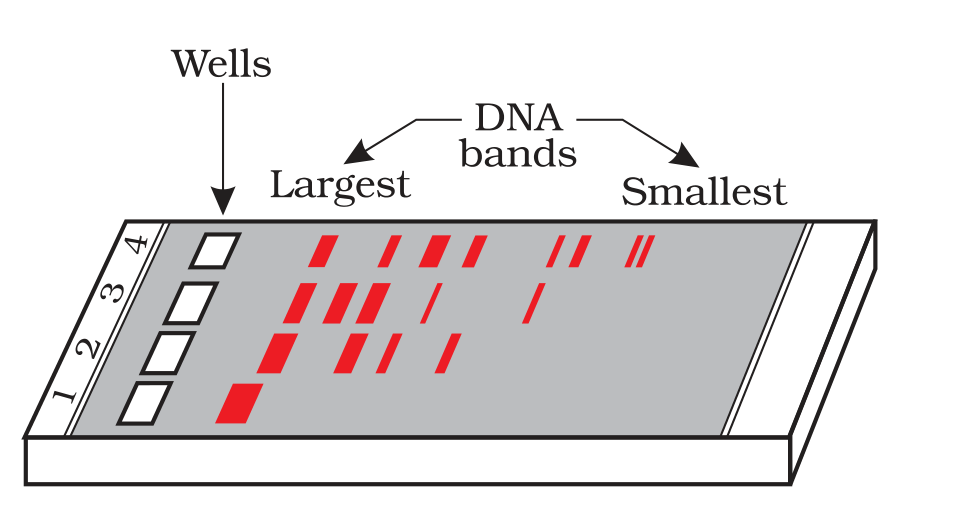
Textbook figure

Figure 9.3 A typical agarose gel electrophoresis showing migration of undigested (lane 1) and digested set of DNA fragments (lane 2 to 4)

Advertisement

Practise more on Biotechnology -Principles and Processes

Chapter-wise mocks on the real NTA exam screen, with solutions and your rank. Your first mocks are free.

Start free mocks →

Advertisement

Next questions

  1. Gifts and remittances received by Indian residents from abroad are recorded in the balance of payments asEconomics · Macro Economics: Open Economy Macro Economics
  2. 68 is 25% of which of the following numbers?General Aptitude Test · Numerical Ability
  3. Paradox of Thrift means:Economics · Macro Economics: Determination of Income and Employment
  4. Consider three long straight parallel wires as shown in the figure. Length of wire B is 25 cm. Choose the correct options.(A) Net force exp…Physics · Moving Charges and Magnetism
  5. Assertion: The concept of mens rea evolved in USA during the 17 Century. Reasoning: In India, the word mens rea, as such, is not defined in…Legal Studies · Topics of Law
  6. Select the most appropriate meaning of the given idiom. Stir up a hornet’s nestEnglish · Grammar: Idioms
  7. Out of the options given below which of them is not a reason for India being a favourite outsourcing destination in the post-reform period?Economics · Indian Economic Development: Liberalisation, Privatisation and Globalisation - An Appraisal
  8. Physics · Magnetism and Matter
  9. वाक्यांशों को सही अनुक्रम में रख कर शुद्ध वाक्य बनाइए -A. सभी करते हैं।B. जो कविC. उसका सम्मानD. लोकप्रिय होता हैनीचे दिए गए विकल्पों में स…Hindi · Grammar - Formation of Sentence
  10. Match the following Years in List 1 with the description associated with it in List 2 about C. Natarajan Annadurai’s life: List- 1(Year) Li…Political Science · Politics in India Since Independence: Challenges to and Restoration of the Congress System