Study the cartoon given below and answer the following question:
Event correlated with the cartoon:
Answer & explanation
Correct answer: option 2
The correct answer is Option (2) → The US response to the 9/11 attack against Al-Qaeda and the Taliban, ‘Operation Enduring Freedom’
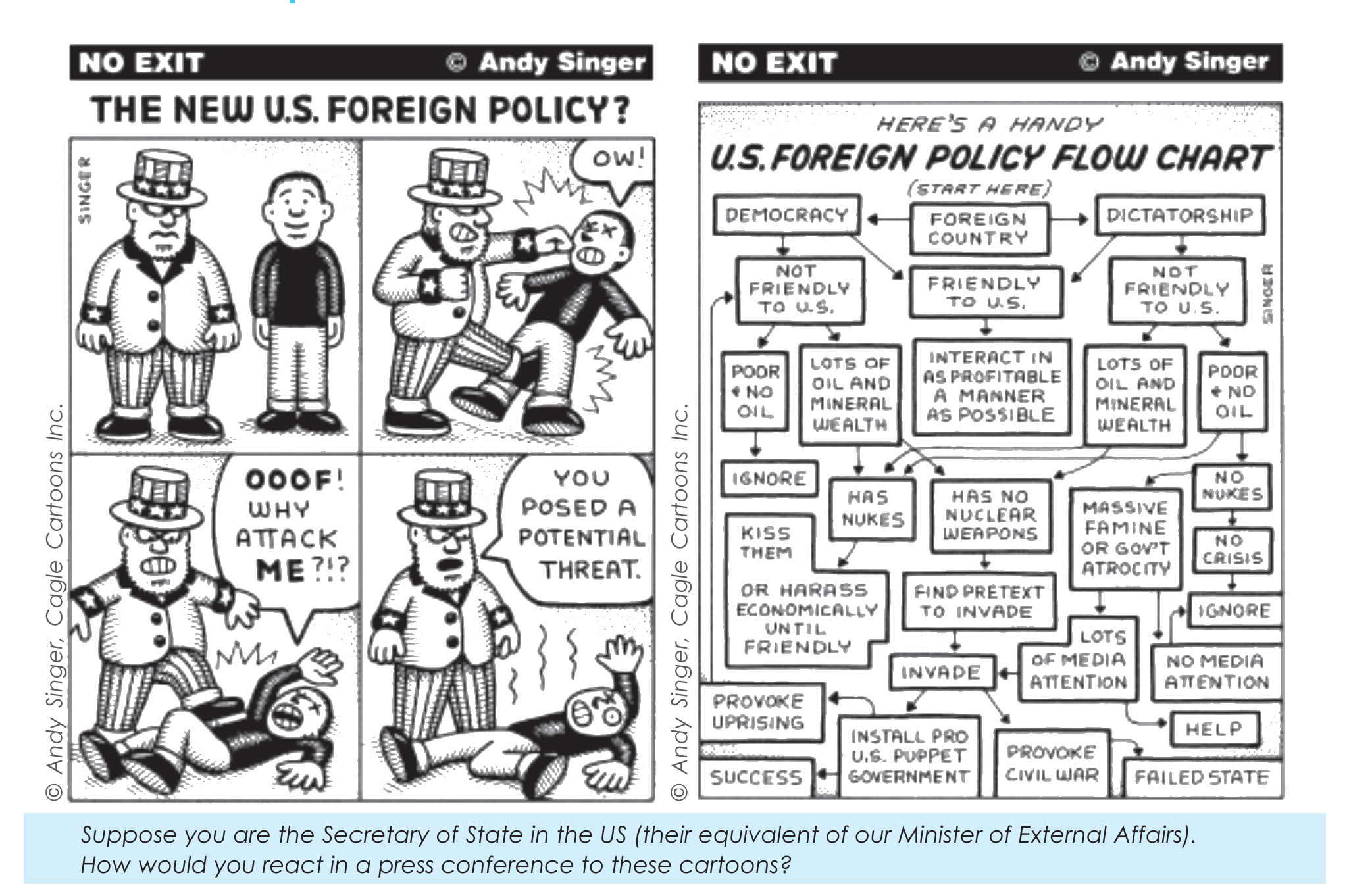
Option (1) Iraq’s invasion of Kuwait in August 1990 — Incorrect. In this event Iraq was the attacker, not the US; the cartoon shows the US attacking someone.
Option (2) The US response to the 9/11 attack against Al-Qaeda and the Taliban, ‘Operation Enduring Freedom’ — Correct. The cartoon stands beside the account of the US response to 9/11: as a part of its ‘Global War on Terror’, the US launched ‘Operation Enduring Freedom’ against all those suspected to be behind the attack, mainly Al-Qaeda and the Taliban regime in Afghanistan.
Option (3) ‘Operation Desert Storm’ — Incorrect. This was the UN operation of the First Gulf War (1991) that drove Iraq out of Kuwait after Iraq had actually invaded it.
Option (4) ‘Operation Infinite Reach’ — Incorrect. These were the cruise missile strikes of 1998 ordered by President Clinton on Al-Qaeda targets in Sudan and Afghanistan after the bombing of the US embassies in Kenya and Tanzania, before 9/11.
Note: This question is taken from the chapter ‘US Hegemony in World Politics’ which was there in the pre-rationalised NCERT and has been deleted from subsequent editions of NCERT, including the NCERT book (2026-27).
NCERT (Pre-rationalised): “The US response to 9/11 was swift and ferocious. Clinton had been succeeded in the US presidency by George W. Bush of the Republican Party, son of the earlier President George H. W. Bush. Unlike Clinton, Bush had a much harder view of US interests and of the means by which to advance them. As a part of its ‘Global War on Terror’, the US launched ‘Operation Enduring Freedom’ against all those suspected to be behind this attack, mainly Al-Qaeda and the Taliban regime in Afghanistan.…”
Cartoons ‘No Exit’ (© Andy Singer, Cagle Cartoons Inc.), chapter ‘US Hegemony in World Politics’: The New U.S. Foreign Policy? |