
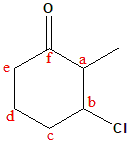
Identify the chiral carbons in the given organic compound.
Answer & explanation
Correct answer: option 3
The correct answer is Option (3) → both a and b
A chiral carbon (asymmetric carbon, stereocentre) is an sp3 carbon bonded to four different groups. Such a carbon makes the molecule non-superimposable on its mirror image.
The compound is 3-chloro-2-methylcyclohexan-1-one: f is the carbonyl carbon, a carries the \( \ce{CH3} \) group, b carries Cl, and c, d, e are \( \ce{CH2} \) groups. Each ring carbon is checked; for a ring carbon, the two ways round the ring count as two groups and are different if they meet different atoms.
a: H, \( \ce{CH3} \), the C=O carbon (f) and the CHCl carbon (b) — four different groups: chiral.
b: H, Cl, the \( \ce{CH(CH3)} \) carbon (a) and the \( \ce{CH2} \) carbon (c) — four different groups: chiral.
c, d, e: each carries two H atoms, so two of its groups are the same: not chiral.
f: the C=O carbon is sp2 with only three groups around it: not chiral.
So the chiral carbons are a and b.
Why the other options are incorrect
Option (1) only a — Incorrect. b also carries four different groups (H, Cl and two different ring branches).
Option (2) only b — Incorrect. a is also chiral (H, \( \ce{CH3} \) and two different ring branches).
Option (4) both a and f — Incorrect. f is the trigonal planar carbonyl carbon and cannot be a stereocentre.
NCERT (2026-27 edition):
Molecular Asymmetry, Chirality and Enantiomers – “… Dutch scientist, J. Van’t Hoff and French scientist, C. Le Bel in the same year (1874), independently argued that the spatial arrangement of four groups (valencies) around a central carbon is tetrahedral and if all the substituents attached to that carbon are different, the mirror image of the molecule is not superimposed (overlapped) on the molecule; such a carbon is called asymmetric carbon or stereocentre.”