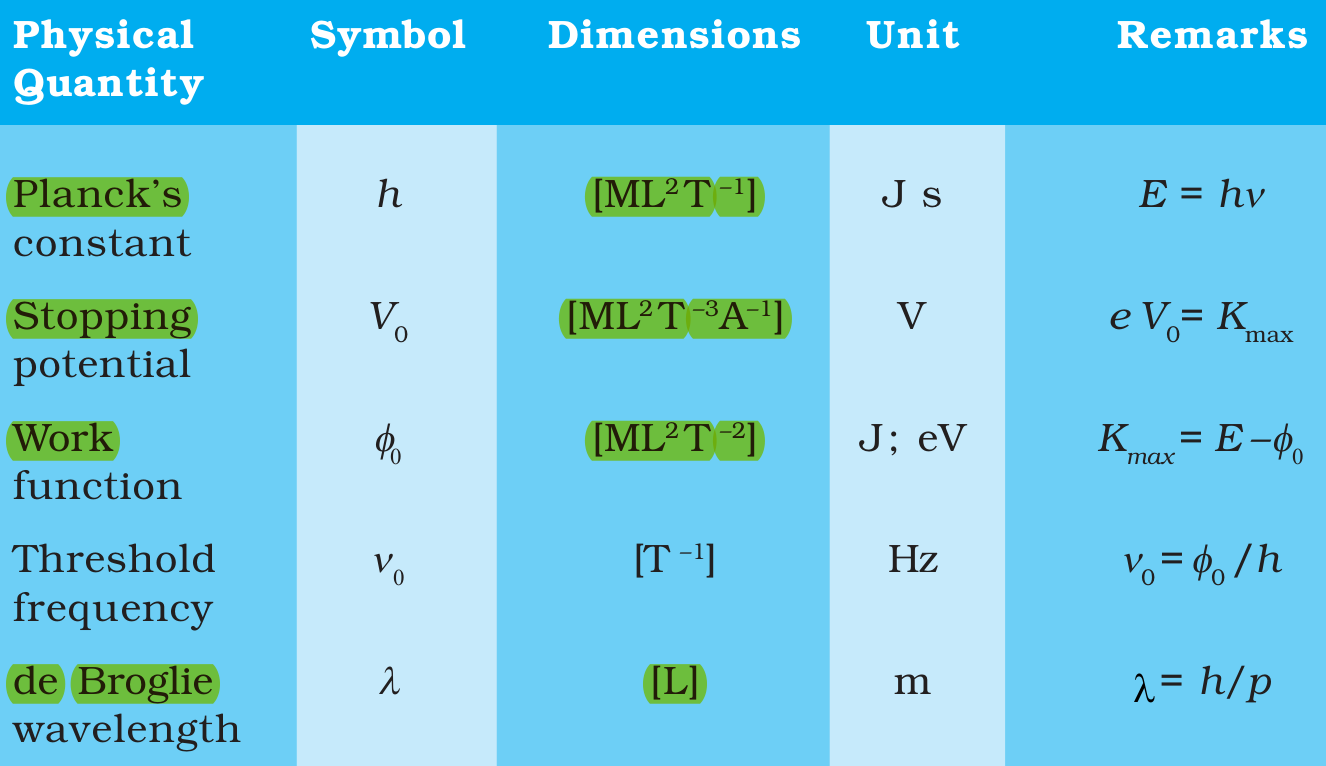
Match List I with List II
LIST I | LIST II | ||
A. | Planck's constant | I. | \( [ML^{2}T^{-2}] \) |
B. | Work function | II. | \( [L] \) |
C. | Stopping potential | III. | \( [ML^{2}T^{-3}A^{-1}] \) |
D. | de Broglie wavelength | IV. | \( [ML^{2}T^{-1}] \) |
Choose the correct answer from the options given below:
Answer & explanation
Correct answer: option 3
The correct answer is Option (3) → A-IV, B-I, C-III, D-II
Find the dimensions of each quantity from a relation that defines it. Energy has dimensions \( [ML^{2}T^{-2}] \).
(A) Planck’s constant — this matches (IV) \( [ML^{2}T^{-1}] \). From \( E = h\nu \), \( h = E/\nu = [ML^{2}T^{-2}]/[T^{-1}] = [ML^{2}T^{-1}] \).
(B) Work function — this matches (I) \( [ML^{2}T^{-2}] \). The work function is the minimum energy needed to remove an electron from the metal.
(C) Stopping potential — this matches (III) \( [ML^{2}T^{-3}A^{-1}] \). Potential is energy per unit charge, and charge has dimensions \( [AT] \), so \( [ML^{2}T^{-2}]/[AT] = [ML^{2}T^{-3}A^{-1}] \).
(D) de Broglie wavelength — this matches (II) \( [L] \). A wavelength is a length.
NCERT (2026-27):
Summary – …