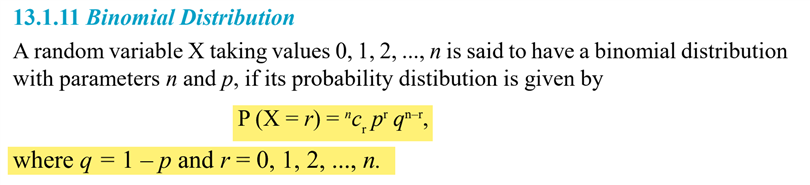
Which of the following is the probability of \(x\) successes in a binomial distribution with number of trials n and probability of success as \(\theta\ (0 \lt \theta \lt 1)\) in each trial?
Answer & explanation
Correct answer: option 2
The correct answer is Option (2) → \({}^{n}c_{x}\,\theta^{x}(1-\theta)^{n-x},\ x=0, 1, 2, \ldots, n\)
In n independent trials with probability of success \(\theta\) in each, the probability of exactly x successes is given by the binomial distribution:
\(P(X=x) = {}^{n}C_{x}\,\theta^{x}(1-\theta)^{n-x},\quad x = 0, 1, 2, \ldots, n\)
Any one arrangement of x successes and n − x failures has probability \(\theta^{x}(1-\theta)^{n-x}\), and the x trials that give the successes can be chosen in \({}^{n}C_{x}\) ways.
Why the other options are incorrect
Option (1) \({}^{n}p_{x}\,\theta^{x}(1-\theta)^{n-x},\ x=0, 1, 2, \ldots, n\) — Incorrect. The positions of the successes are a selection, not an arrangement, so the count is \({}^{n}C_{x}\), not \({}^{n}P_{x}\).
Option (3) \({}^{n}c_{x}\,\theta\,(1-\theta),\ x=0, 1, 2, \ldots, n\) — Incorrect. The powers are missing: x successes give \(\theta^{x}\) and n − x failures give \((1-\theta)^{n-x}\).
Option (4) \({}^{n}c_{x}\,\theta^{x}(1-\theta)^{x},\ x=0, 1, 2, \ldots, n\) — Incorrect. The power of \((1-\theta)\) must be the number of failures, n − x, not x.
NCERT Exemplar:
Probability