Read the following passage and answer the question.
Mr. Raju is the factory manager of M/s Playing Kids Pvt. Ltd., a toy manufacturing company. In order to ensure unity of command, Mr. Raju appointed just one foreman, Mr. Surya, for the entire production planning, implementation and control of the workmen. However, Surya was not competent enough to supervise both planning and execution. This reduced the quality of work and the efficiency of the workmen. Mr. Raju also expects his subordinates to adapt to a new environment and new working conditions without giving them time to settle down. A good practice in the company is that every piece of equipment, and even every person, has a prescribed place. Mr. Raju gave his subordinate the duty of collecting samples of toys from the office, but the subordinate could not do the task, as only superiors and top executives were allowed to enter the office.
Taylor proposed a technique of scientific management for the kind of decision Mr. Raju made about Surya. Which of the following is a feature of that technique?
Answer & explanation
Correct answer: option 2
The correct answer is Option (2) → Each worker takes orders from eight specialists, each in charge of one function.
Option (1) The amount and frequency of rest intervals of workers are fixed. — Incorrect. This is a feature of fatigue study. Rest intervals help a tired worker regain stamina.
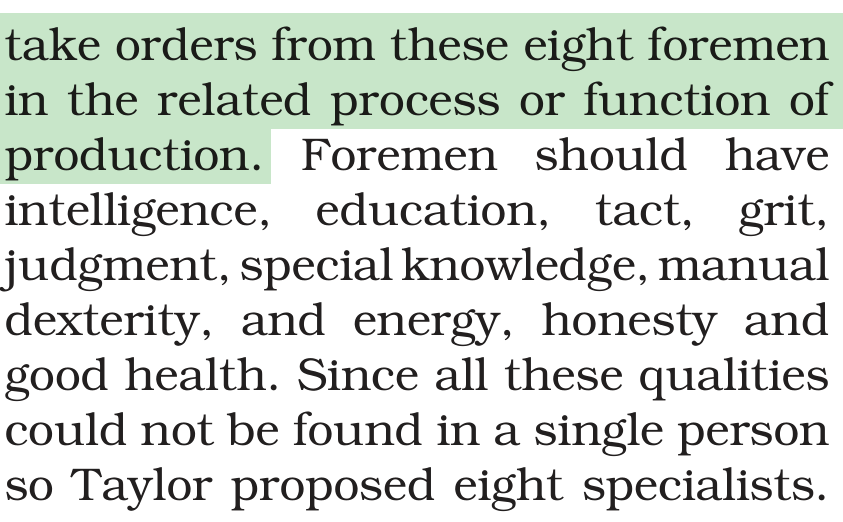
Option (2) Each worker takes orders from eight specialists, each in charge of one function. — Correct. Mr. Raju gave one foreman all of planning, doing and control. Taylor found that no single person has all the qualities this needs. So functional foremanship separates planning from execution and uses eight specialist foremen. Each worker takes orders from all eight, each in his own function.
Option (3) A standard time is fixed for each well-defined job. — Incorrect. Fixing a standard time for a job is time study. It tells how long a task should take and helps decide wages and the number of workers.
Option (4) Superfluous varieties, sizes and dimensions of products are eliminated. — Incorrect. Removing needless varieties, sizes and dimensions is simplification of work. It deals with the range of products a firm makes.
NCERT (2026-27 Edition): “Functional Foremanship In the factory system, the foreman represents the managerial figure with whom the workers are in face-to-face contact on a daily basis. In the first chapter of the book, you have seen that the foreman is the lowest ranking manager and the highest ranking worker. He is the pivot around whom revolves the entire production planning, implementation and control. Thus, Taylor concentrated on improving the performance of this role in the factory set-up. In fact, he identified a list of qualities of a good foreman/supervisor and found that no single person could fit them all. This prompted him to suggest functional foremanship through eight persons. …” “Functional Foremanship … Functional foremanship is an extension of the principle of division of work and specialisation to the shop floor. Each worker will have to…”
|