
CUETMOCK
  • Pricing
  • Mentors
Log inStart freeStart free mocks→

First test, then trust

Try a free CUET mock test.

Join 5,00,000+ students who rehearsed exam day on the exact NTA screen before sitting CUET. On the web and on Android.

Start free mocks →Get the Android app
CUETMOCK

India's #1 CUET Mock Test Platform. Original NCERT-based questions on the exact NTA exam screen — trusted by 5,00,000+ students since CUET 2022.

Get it onGoogle PlayScan to download the CUETMOCK app

Mock tests

  • CUET mock test series
  • Commerce mocks
  • Humanities (Arts) mocks
  • Science mocks
  • Languages & GAT mocks
  • Free practice questions
  • Pricing

Resources

  • CUET exam guide
  • CUET syllabus
  • Universities accepting CUET
  • Expert blogs
  • News & notifications
  • Webinars & counselling
  • CUET score calculator
  • How we estimate your rank
  • FAQs

Company

  • About us
  • Our leadership & team
  • Our toppers
  • Mentors
  • For schools
  • Contact us
  • Terms
  • Privacy
  • Refund policy

Talk to us

+91 7696 6630 56info@cuetmock.comWhatsApp us

Our other platforms

  • JEE Mock — For IIT-JEE aspirants
  • NEET Mock — For NEET aspirants

Newsletter

Exam updates, study material and offers — no spam.

© 2026 NYC Ventures Pvt. Ltd.

701-702, Royal Business Park, Zirakpur, Punjab - 140603

  • Terms of use
  • Privacy policy
  • Refund policy
  • Contact us

iCUETMOCK is an independent preparation platform, not affiliated with the National Testing Agency (NTA). Always check exam details on the official NTA website.

  • Home
  • Mock tests
  • CUET guide
  • Pricing
  • Log in
Home/Practice questions/Chemistry
ChemistryOrganic: Biomolecules

The figure shows the double strand helix structure of a segment of DN…

The figure shows the double strand helix structure of a segment of DNA.
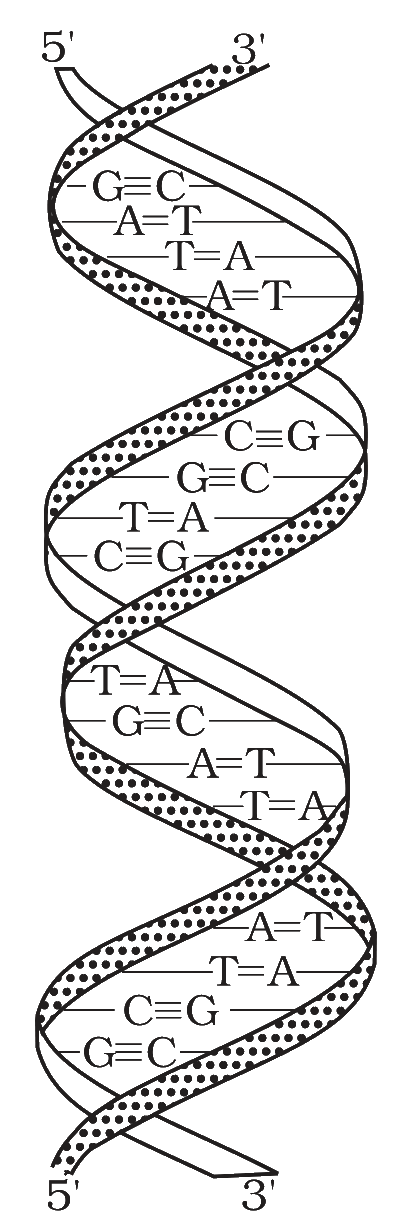
Double strand helix structure for DNA

Which of the following statements about the DNA segment shown in the figure is correct?

Answer & explanation+

Correct answer: option 4

The correct answer is Option (4) → The segment contains 14 bases that are either guanine or cytosine.

  • The two strands of DNA are held together by hydrogen bonds between specific pairs of bases: adenine pairs with thymine and cytosine pairs with guanine. Each base pair therefore has one base from each strand, and each base belongs to one nucleotide (base + sugar + phosphate).

  • Counting the figure — the segment shows 16 base pairs: 7 G–C pairs (G≡C or C≡G) and 9 A–T pairs (A=T or T=A). Guanine = cytosine = 7; adenine = thymine = 9. Total bases = 16 × 2 = 32.

Option (4) The segment contains 14 bases that are either guanine or cytosine. — Correct. Each of the 7 G–C pairs has one guanine and one cytosine, so 7 × 2 = 14 bases are guanine or cytosine.

Why the other options are incorrect

Option (1) The segment contains 16 nucleotides. — Incorrect. 16 is the number of base pairs, not nucleotides. Each pair has two bases, one in each strand, so the segment has 16 × 2 = 32 nucleotides.

Option (2) The segment contains equal numbers of adenine and guanine bases. — Incorrect. Adenine pairs with thymine, not with guanine, so the number of adenine bases equals the number of A–T pairs (9); guanine equals the number of G–C pairs (7), and 9 ≠ 7.

Option (3) The segment contains fewer thymine bases than cytosine bases. — Incorrect. Thymine bases = 9 (one in each A–T pair) and cytosine bases = 7 (one in each G–C pair), so the segment has more thymine than cytosine, not fewer.

NCERT (2026-27 edition):
10.5.2 Structure of Nucleic Acids – “A unit formed by the attachment of a base to 1′ position of sugar is known as nucleoside. … When nucleoside is linked to phosphoric acid at 5′-position of sugar moiety, we get a nucleotide ….”

“…James Watson and Francis Crick gave a double strand helix structure for DNA (Fig. 10.7). Two nucleic acid chains are wound about each other and held together by hydrogen bonds between pairs of bases. The two strands are complementary to each other because the hydrogen bonds are formed between specific pairs of bases. Adenine forms hydrogen bonds with thymine whereas cytosine forms hydrogen bonds with guanine.”

Fig. 10.7

Fig. 10.7: Double strand helix structure for DNA

Advertisement

Practise more on Organic: Biomolecules

Chapter-wise mocks on the real NTA exam screen, with solutions and your rank. Your first mocks are free.

Start free mocks →

Advertisement

Next questions

  1. Which of the following wave is used in telecommunication?Physics · Electromagnetic Waves
  2. The committee's final decision best illustrates which of the following?Psychology · Social Influence and Group Processes
  3. Two wires A and B of the same material and same mass have radii 2r and r , respectively. If the resistance of wire A is 4 Ω , then resistan…Physics · Current Electricity
  4. Select the most appropriate one-word substitution for the given group of words. A small enclosure for cattle, sheep, poultry etc.English · One Word
  5. Halley’s Comet can be seen from the Earth after a gap of about how many years?General Aptitude Test · General Knowledge
  6. Study the given graph and answer the question that follows. The chart represents the demand and production of leather bags by five companie…General Aptitude Test · Quantitative Reasoning
  7. निम्नलिखित में से ब्रजभाषा कौन-सी हिंदी के अंतर्गत आती है?Hindi · व्याकरण - सभाषा
  8. What is the order of reactivity of (I)HCHO (II) CH3CHO (III) C6H5CHO towards nucleophile?Chemistry · Organic: Aldehydes, Ketones and Carboxylic Acids
  9. On dissolution of a firm, the amount of loan taken from partner by firm will be transferred to:Accountancy Part A · Dissolution of Partnership Firm
  10. The correct sequence involved in calculation of goodwill by weighted average profit method is : A. Adjust the profit taking into account ab…Accountancy Part A · Admission of a Partner