What are the broad components of money supply measure M3?
A. Currency in circulation
B. Net fixed deposits with the banking system
C. Post office savings deposit
D. Demand Deposits
Choose the correct answer from the options given below:
Answer & explanation
Correct answer: option 2
The correct answer is Option (2) → A, B and D only
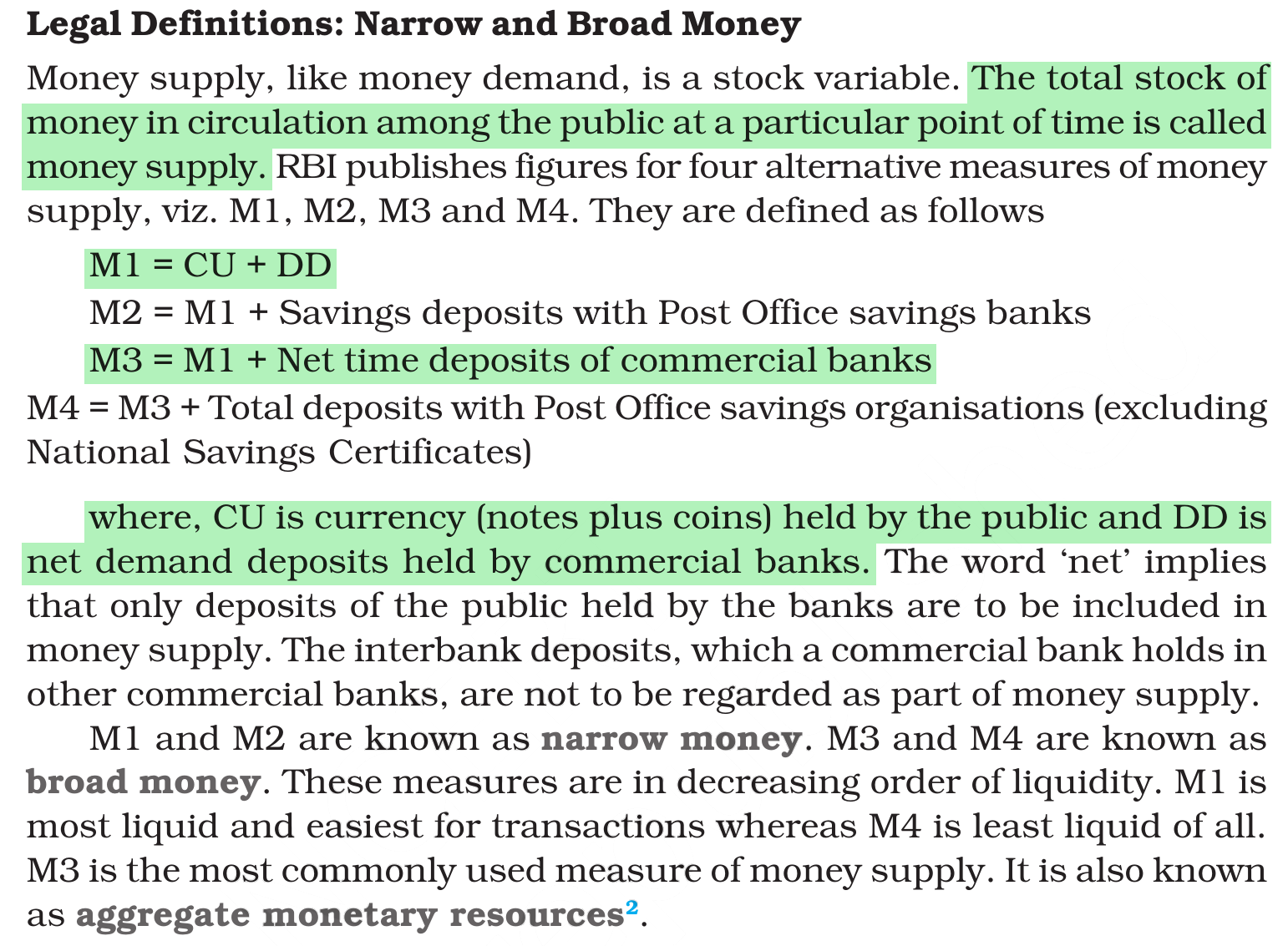
The money people hold, as notes and coins and as bank deposits they can draw on, makes up the money supply. The RBI measures it in four ways, M1 to M4. M1 is currency held by the public plus demand deposits with the banks; M3, the most commonly used measure, adds the net time deposits of commercial banks, that is, their fixed deposits:
M3 = M1 + Net time deposits of commercial banks
Post office deposits come in only in M2 and M4, so three of the four items belong to M3:
(A) Currency in circulation. Included. It is part of M1, on which M3 is built.
(B) Net fixed deposits with the banking system. Included. Fixed deposits are time deposits, which is what M3 adds to M1.
(C) Post office savings deposit. Not included. Post office savings deposits enter M2, and all post office deposits enter M4; they are held with the post office savings organisation, not with the commercial banks.
(D) Demand Deposits. Included. Again through M1.
NCERT: Introductory Macroeconomics — Chapter 3: Money and Banking (2025-26)
|