
The potentials are applied to the four p-n junctions as shown below:
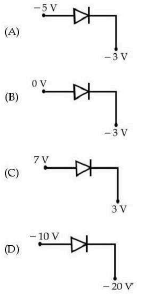
The forward biased p-n junctions are:
Answer & explanation
Correct answer: option 3
The correct answer is Option (3) → (B), (C) and (D) only
A p-n junction is forward biased when the \textbf{p-side (anode)} is at a higher potential than the \textbf{n-side (cathode)}.
We check $V_p > V_n$ in each case:
(A)
$V_p = -5V, \quad V_n = -3V$
$-5 < -3$
p-side is at lower potential $\rightarrow$ Reverse biased
(B)
$ V_p = 0V, \quad V_n = -3V$
$0 > -3$
p-side higher $\rightarrow$ Forward biased
(C)
$V_p = 7V, \quad V_n = 3V$
$7 > 3 $
p-side higher $\rightarrow$ Forward biased
(D)
$ V_p = -10V, \quad V_n = -20V $
$ -10 > -20 $
p-side higher $\rightarrow$ Forward biased