
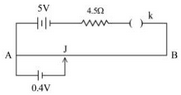
In the given figure, the potentiometer wire, AB has a resistance of \( 5\,\Omega \) and length 10 m. The balancing length AJ for 0.4 V is nearly:
Answer & explanation
Correct answer: option 2
The correct answer is Option (2) → 1.52 m
At balance, the potential difference across AJ equals the emf being measured. The wire has a uniform potential gradient \( k = V_{AB}/L \), so the balancing length is \( l = 0.4\,\mathrm{V}/k \).
From the figure, the 5 V driver cell, the \( 4.5\,\Omega \) resistor and the wire AB are in series. The driver cell is taken as ideal.
\( \displaystyle I = \frac{5\,\mathrm{V}}{4.5\,\Omega + 5\,\Omega} = \frac{5}{9.5}\,\mathrm{A} \approx 0.526\,\mathrm{A} \)
\( \displaystyle V_{AB} = I R_{AB} = 0.526 \times 5 = 2.63\,\mathrm{V} \)
\( \displaystyle k = \frac{V_{AB}}{L} = \frac{2.63\,\mathrm{V}}{10\,\mathrm{m}} = 0.263\,\mathrm{V\,m^{-1}} \)
\( \displaystyle AJ = \frac{0.4\,\mathrm{V}}{0.263\,\mathrm{V\,m^{-1}}} \approx 1.52\,\mathrm{m} \)
Note: This question is from the pre-rationalised NCERT book (2022-23). The topic was removed from the latest NCERT book (2026-27), and it also appears to be out of the CUET 2026 syllabus.
NCERT (Pre-rationalised edition, 2022-23):
Potentiometer – “… A current I flows through the wire which can be varied by a variable resistance (rheostat, R) in the circuit. Since the wire is uniform, the potential difference between A and any point at a distance l from A is
\( \displaystyle \varepsilon(l) = \phi\, l \qquad (3.89) \)
where φ is the potential drop per unit length.”