
The figure shows the formation of a dinucleotide from two nucleotides, an upper one and a lower one.
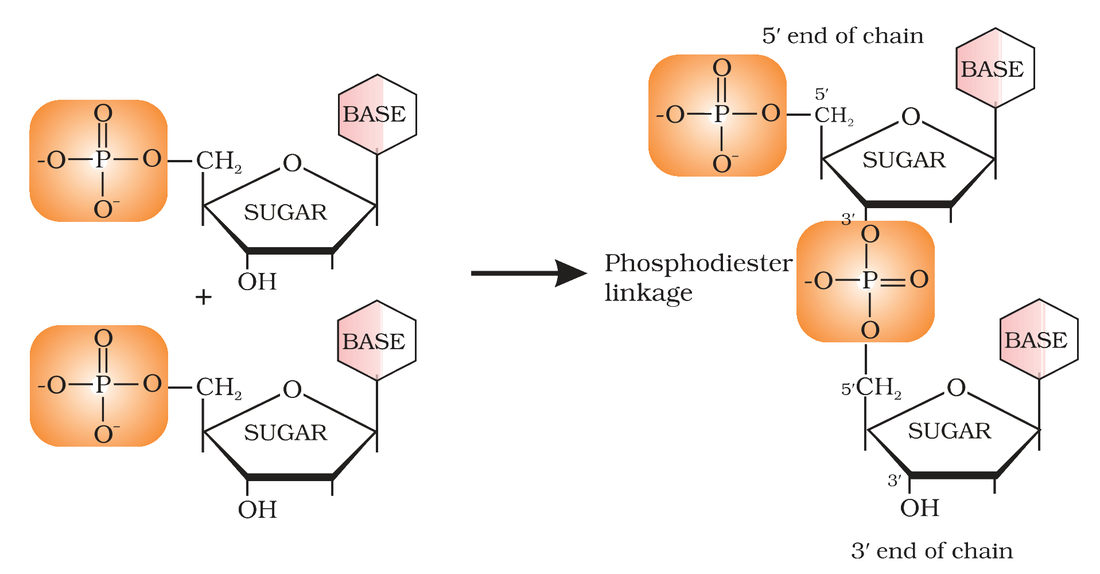
Which groups of the two nucleotides react to form the phosphodiester linkage in the product?
Answer & explanation
Correct answer: option 4
The correct answer is Option (4) → The phosphate group (at 5′) of the lower nucleotide and the 3′–OH group of the upper nucleotide
Nucleotides are joined by a phosphodiester linkage between the 5′ and 3′ carbon atoms of the sugars, so a phosphate group on the 5′ carbon of one nucleotide bonds to the 3′ carbon of the other.
Upper nucleotide — it keeps its own phosphate at 5′ (the 5′ end of the chain), but its 3′–OH is gone: its 3′ carbon is now bonded through O to the linking phosphate.
Lower nucleotide — it keeps its 3′–OH (the 3′ end of the chain), and its 5′ phosphate is the one that links to the upper sugar.
Why the other options are incorrect
Option (1) The phosphate group (at 5′) of the upper nucleotide and the 3′–OH group of the lower nucleotide — Incorrect. This reverses the two nucleotides. In the product the upper nucleotide still has a free phosphate at its 5′ end and the lower one still has a free 3′–OH.
Option (2) The phosphate group (at 5′) of the lower nucleotide and the base of the upper nucleotide — Incorrect. The base stays on the 1′ carbon of each sugar; the linkage is between sugar carbons, 5′ and 3′, not with a base.
Option (3) The phosphate group (at 5′) of the upper nucleotide and the phosphate group of the lower nucleotide — Incorrect. The product has no P–O–P bond; the linking phosphate is bonded through oxygen to two sugar carbons.
NCERT (2026-27 edition):
10.5.2 Structure of Nucleic Acids – “When nucleoside is linked to phosphoric acid at 5′-position of sugar moiety, we get a nucleotide (Fig. 10.5).”
“Nucleotides are joined together by phosphodiester linkage between 5′ and 3′ carbon atoms of the pentose sugar. The formation of a typical dinucleotide is shown in Fig. 10.6.”
Fig. 10.6: Formation of a dinucleotide