Consider the following sequence of reaction:

The final product (Z) is
Answer & explanation
Correct answer: option 2
The correct answer is Option (2) → bromobenzene
The sequence is reduction, diazotisation, then Sandmeyer reaction. The nitrogen of the nitro group stays on the ring until the last step, where it leaves as \( \ce{N2} \) and is replaced by the halogen of the copper(I) reagent.
First, tin and hydrochloric acid reduce nitrobenzene to aniline (X):
\( \displaystyle \ce{C6H5NO2 + 6[H]} \xrightarrow{\ce{Sn}/\ce{HCl}} \ce{C6H5NH2 + 2H2O} \)
Next, \( \ce{NaNO2} \) and HCl form nitrous acid in the mixture, which converts aniline at 273–278 K into benzenediazonium chloride (Y):
\( \displaystyle \ce{C6H5NH2 + NaNO2 + 2HCl} \xrightarrow{273-278\,\mathrm{K}} \ce{C6H5N2^+Cl^- + NaCl + 2H2O} \)
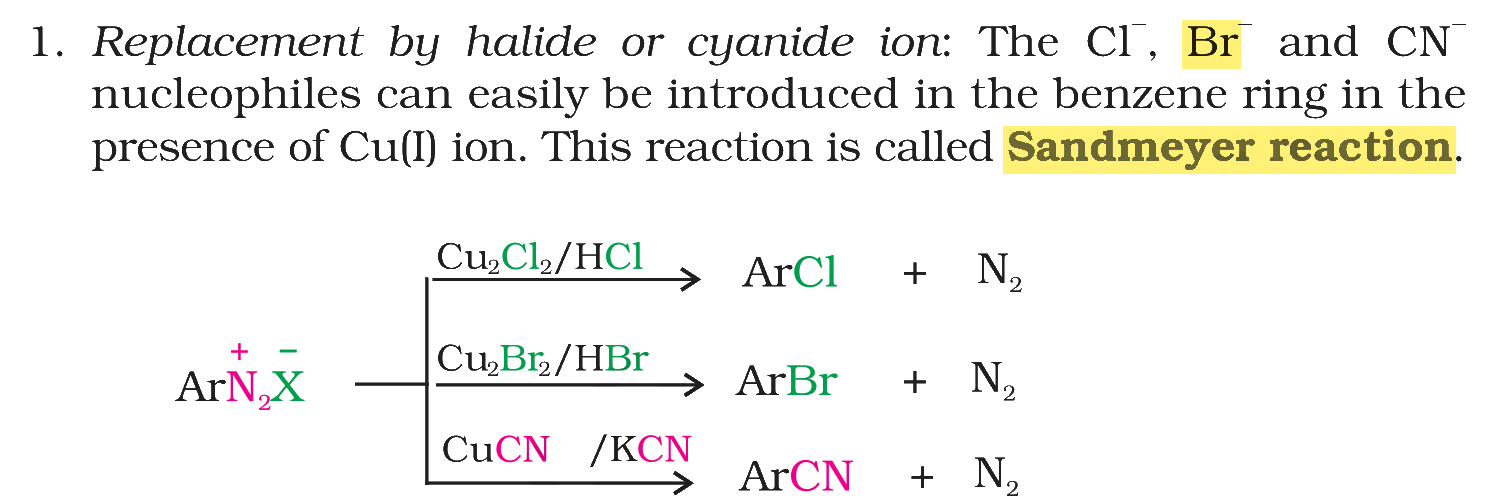
Finally, CuBr in HBr replaces the diazonium group by bromine (Sandmeyer reaction), and nitrogen gas escapes:
\( \displaystyle \ce{C6H5N2^+Cl^- + HBr} \xrightarrow{\ce{CuBr}} \ce{C6H5Br + N2 ^ + HCl} \)
The halogen comes from the CuBr/HBr pair, and the bromine is joined directly to the ring carbon that carried the nitrogen. So Z is bromobenzene.
NCERT (2026-27 edition):
9.9 Chemical Reactions