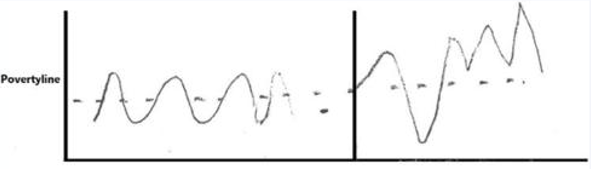
The above diagram shows the categories of poverty. This type of poverty is known as
Answer & explanation
Correct answer: option 2
The correct answer is Option (2) → Transient Poor
In both graphs, income goes above and below the poverty line. People who move in and out of poverty are the transient poor.
In the left graph, income crosses the line again and again. These are the churning poor, such as small farmers and seasonal workers. In the right graph, income stays above the line most of the time and falls below it once. These are the occasionally poor, who are rich most of the time but may have a patch of bad luck.
Option (1) Chronic poor — Incorrect. They are always poor, or usually poor with a little more money at times, such as casual workers. Their income stays mostly below the line.
Option (2) Transient Poor — Correct. The churning poor and the occasionally poor together form this group.
Option (3) Non poor — Incorrect. They are never poor, so their income never falls below the line.
Option (4) Full poor — Incorrect. There is no such category of poverty.
Note: This question is taken from the chapter ‘Poverty’ which was there in the pre-rationalised NCERT and has been deleted from subsequent editions of NCERT, including the NCERT book (2026-27). The chapter was also not in the CUET (UG) 2026 syllabus.
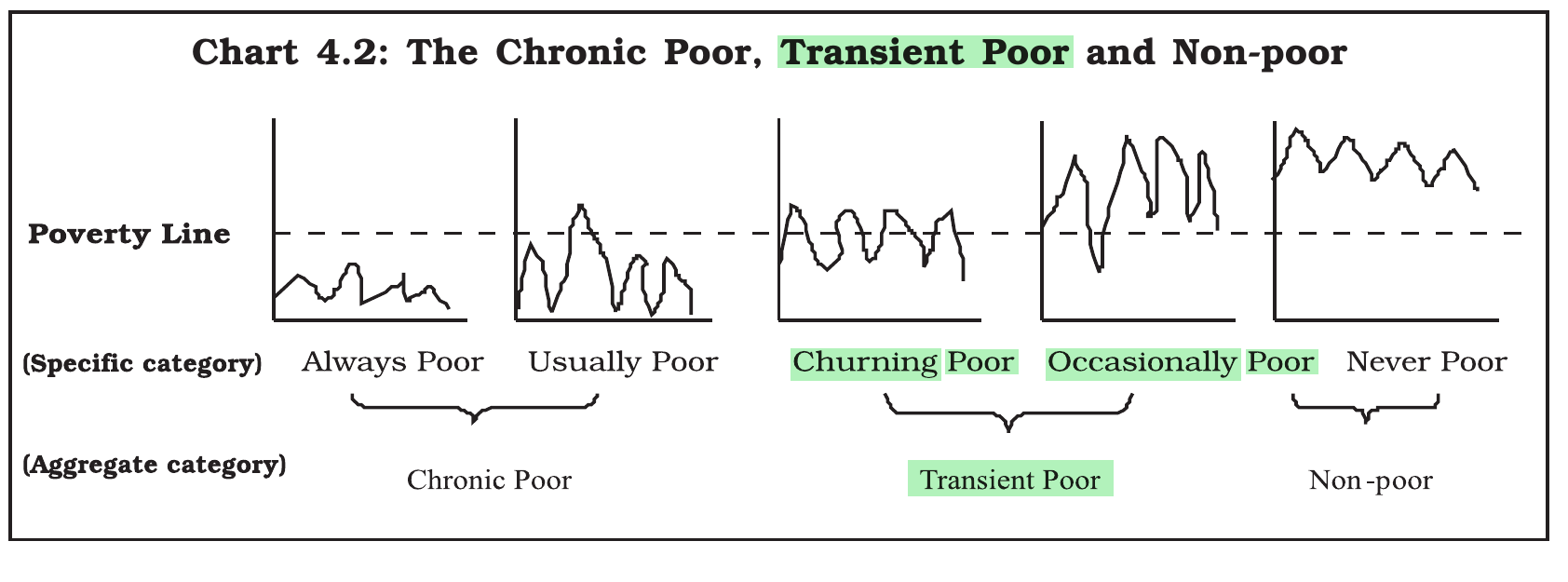
NCERT (Pre-rationalised): “4.3 How are Poor People Identified? … Categorising Poverty: There are many ways to categorise poverty. In one such way people who are always poor and those who are usually poor but who may sometimes have a little more money (example: casual workers) are grouped together as the chronic poor. Another group are the churning poor who regularly move in and out of poverty (example: small farmers and seasonal workers) and the occasionally poor who are rich most of the time but may sometimes have a patch of bad luck. They are called the transient poor. And then, there are those who are never poor and they are the non-poor (Chart 4.2).…”
|