
Read the passage carefully and answer the Questions.
Molar conductivity ($Λ_m$) of a solution at a given concentration (c) is the conductance of volume, V of solution, containing one mole of electrolyte kept between the two electrodes with area of cross-section A and at a distance of unit length. It increases with the decrease in concentration and when the concentration approaches zero, the molar conductivity is called limiting molar conductivity ($Λ^0_m$). For a strong electrolyte, $Λ_m$ increases linearly with dilution and is given by $Λ_m = Λ^0_m -Ac^{1/2}$. The value of the constant $Λ_m$ for a given solvent depends on the type of electrolyte along with temperature. According to Kohlrausch law, the value of $Λ^0_m$ for an electrolyte is $Λ^0_m=v_+λ^0_+v_-λ^0_-$, where $v_+$ and $v_-$ are the number of cations and anions, respectively, per molecule of the electrolyte and $λ^0_+$ and $λ^0_-$ are limiting molar conductivities of cation and anion, respectively. Kohlrausch law finds many applications, like determining the solubility of a sparingly soluble salt, determining the degree of dissociation ($Λ^0_m/$Λ_m$) and the dissociation constant of a weak electrolyte.
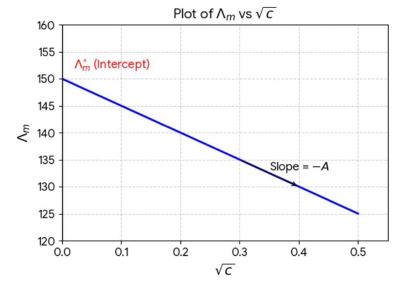
The plot between $Λ_m$ and $c^{1/2}$ is a straight line with
Answer & explanation
Correct answer: option 4
The correct answer is Option (4) → Slope = -A and intercept = $Λ^0_m$
Core Concept
For strong electrolytes:
Λₘ = Λₘ° − Ac¹ᐟ²
This is of the form:
y = b + mx
Comparing:
Λₘ = Λₘ° + (−A)c¹ᐟ²
Slope = −A
Intercept = Λₘ°
Detailed Explanation
When Λₘ is plotted against √c:
Straight line is obtained
Intercept on y-axis = Λₘ°
Slope = −A