Match List-I with List-II:
| List-I Leaders | List-II Associative-Regions | ||
| (A) | Hanwant Singh | (I) | Kalakankar |
| (B) | Begum Hazrat Mahal | (II) | Lucknow |
| (C) | Shah Mal | (III) | Chotanagpur |
| (D) | Gonoo | (IV) | Barout |
Choose the correct answer from the options given below:
Answer & explanation
Correct answer: option 1
The correct answer is Option (1) → (A) - (I), (B) - (II), (C) - (IV), (D) - (III)
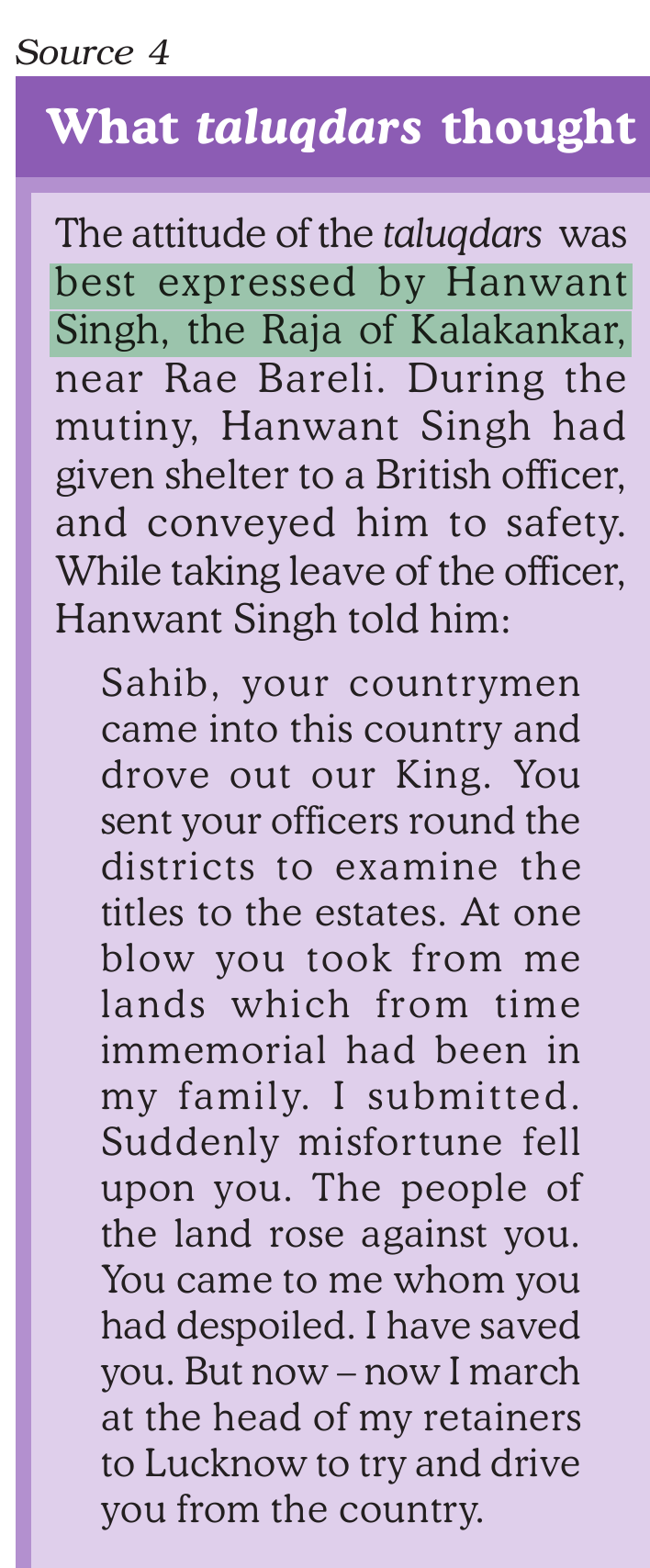
(A) Hanwant Singh — this matches (I) Kalakankar. Hanwant Singh, the Raja of Kalakankar near Rae Bareli, gave shelter to a British officer during the mutiny and took him to safety; his words to the officer show what the taluqdars thought of British rule.
(B) Begum Hazrat Mahal — this matches (II) Lucknow. Many taluqdars of Awadh, loyal to the Nawab, joined Begum Hazrat Mahal, the Nawab’s wife, in Lucknow to fight the British.
(C) Shah Mal — this matches (IV) Barout. Shah Mal mobilised the villagers of pargana Barout in Uttar Pradesh.
(D) Gonoo — this matches (III) Chotanagpur. Gonoo, a tribal cultivator of Singhbhum in Chotanagpur, became a rebel leader of the Kol tribals.
NCERT (2025-26): “1.3 Leaders and followers … Elsewhere, local leaders emerged, urging peasants, zamindars and tribals to revolt. Shah Mal mobilised the villagers of pargana Barout in Uttar Pradesh; Gonoo, a tribal cultivator of Singhbhum in Chotanagpur, became a rebel leader of the Kol tribals of the region. 2.3 Firangi raj and the end of a world … In areas like Awadh where resistance during 1857 was intense and long lasting, the fighting was carried out by taluqdars and their peasants. Many of these taluqdars were loyal to the Nawab of Awadh, and they joined Begum Hazrat Mahal (the wife of the Nawab) in Lucknow to fight the British; some even remained with her in defeat.…”
|