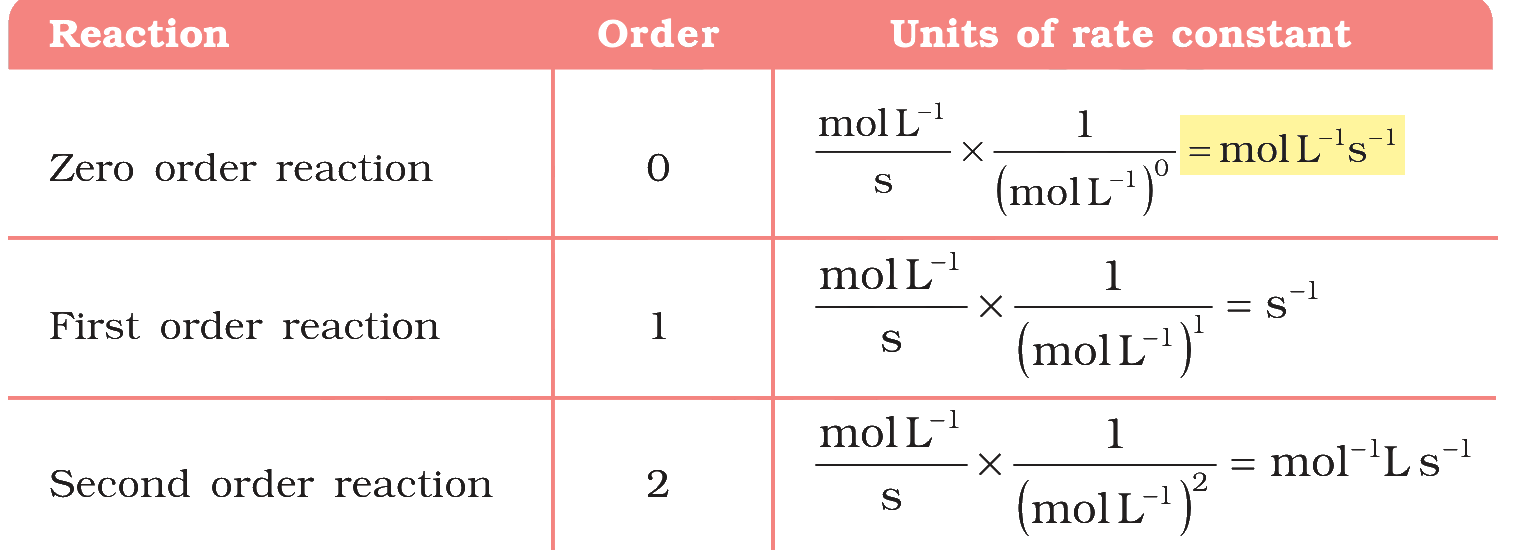
Find the order of reaction having rate constant 1.5 × 10⁻³ L−1 mol s−1.
Answer & explanation
Correct answer: option 1
The correct answer is Option (1) → Zero
The rate of a reaction is the change in concentration per unit time, so its unit is always mol L−1 s−1. The unit of the rate constant k changes with the order, and it can be worked out from the rate law.
For a reaction of order n:
\( \displaystyle \text{Rate}=k[\mathrm{A}]^{n}\quad\Rightarrow\quad k=\frac{\text{Rate}}{[\mathrm{A}]^{n}} \)
Putting in the units:
\( \displaystyle \text{Unit of }k=\frac{\mathrm{mol\,L^{-1}\,s^{-1}}}{(\mathrm{mol\,L^{-1}})^{n}}=(\mathrm{mol\,L^{-1}})^{1-n}\,\mathrm{s^{-1}} \)
For a third order reaction (n = 3) the same rule gives:
Third order (n = 3): Rate = k[A]3
\( \displaystyle \text{Unit of }k=\frac{\mathrm{mol\,L^{-1}\,s^{-1}}}{\mathrm{mol^{3}\,L^{-3}}}=\mathrm{mol^{-2}\,L^{2}\,s^{-1}} \)
The given unit, L−1 mol s−1, is mol L−1 s−1 written in a different order. It is the same as the unit of rate, so the reaction is of zero order.
Shortcut: When k has the same unit as the rate (mol L−1 s−1), the order is zero.
NCERT (2026-27 edition):
Units of Rate Constant – …