
CUETMOCK
  • Pricing
  • Mentors
Log inStart freeStart free mocks→

First test, then trust

Try a free CUET mock test.

Join 5,00,000+ students who rehearsed exam day on the exact NTA screen before sitting CUET. On the web and on Android.

Start free mocks →Get the Android app
CUETMOCK

India's #1 CUET Mock Test Platform. Original NCERT-based questions on the exact NTA exam screen — trusted by 5,00,000+ students since CUET 2022.

Get it onGoogle PlayScan to download the CUETMOCK app

Mock tests

  • CUET mock test series
  • Commerce mocks
  • Humanities (Arts) mocks
  • Science mocks
  • Languages & GAT mocks
  • Free practice questions
  • Pricing

Resources

  • CUET exam guide
  • CUET syllabus
  • Universities accepting CUET
  • Expert blogs
  • News & notifications
  • Webinars & counselling
  • CUET score calculator
  • How we estimate your rank
  • FAQs

Company

  • About us
  • Our leadership & team
  • Our toppers
  • Mentors
  • For schools
  • Contact us
  • Terms
  • Privacy
  • Refund policy

Talk to us

+91 7696 6630 56info@cuetmock.comWhatsApp us

Our other platforms

  • JEE Mock — For IIT-JEE aspirants
  • NEET Mock — For NEET aspirants

Newsletter

Exam updates, study material and offers — no spam.

© 2026 NYC Ventures Pvt. Ltd.

701-702, Royal Business Park, Zirakpur, Punjab - 140603

  • Terms of use
  • Privacy policy
  • Refund policy
  • Contact us

iCUETMOCK is an independent preparation platform, not affiliated with the National Testing Agency (NTA). Always check exam details on the official NTA website.

  • Home
  • Mock tests
  • CUET guide
  • Pricing
  • Log in
Home/Practice questions/Chemistry
ChemistryPhysical: Chemical Kinetics

For the reaction2N2O5(g) → 4NO2(g) + O2(g)The rate is expressed as:

For the reaction

2N2O5(g) → 4NO2(g) + O2(g)

The rate is expressed as:

Answer & explanation+

Correct answer: option 1

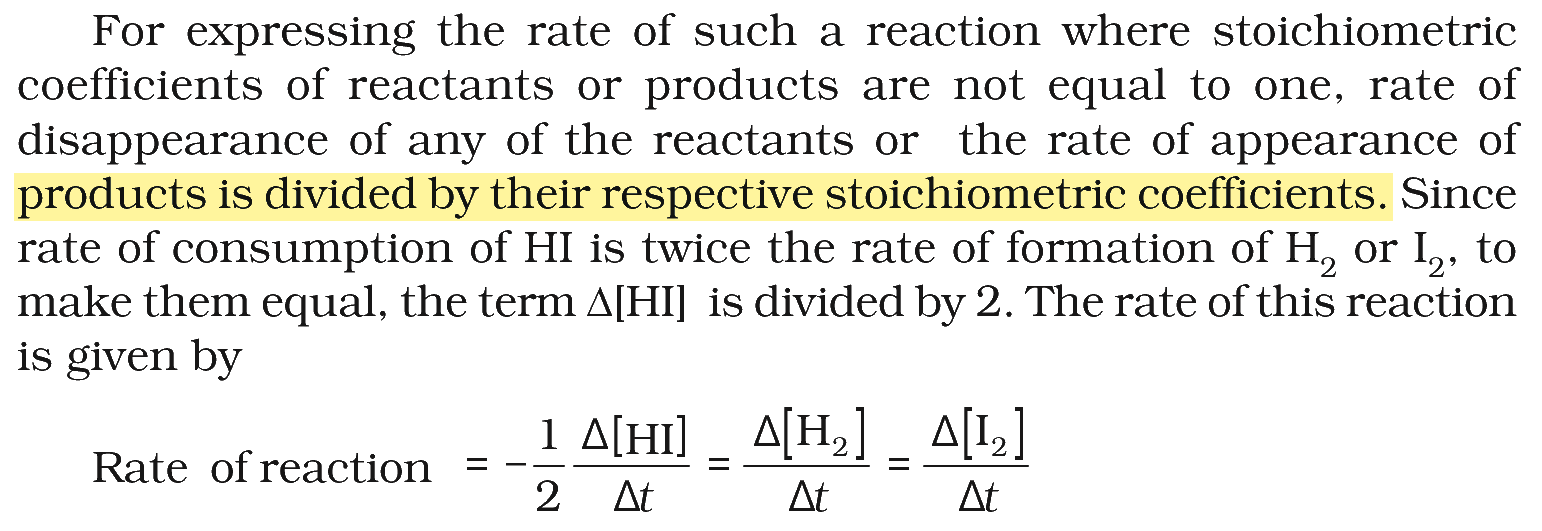
The correct answer is Option (1) → \( \displaystyle -\frac{\Delta[\ce{N2O5}]}{2\,\Delta t}=\frac{\Delta[\ce{NO2}]}{4\,\Delta t}=\frac{\Delta[\ce{O2}]}{\Delta t} \)

The rate of a reaction must have one value, whichever substance is used to follow it. For a general reaction

    \( \displaystyle \ce{aA + bB -> cC + dD} \)

    \( \displaystyle \text{Rate}=-\frac{1}{a}\frac{\Delta[\ce{A}]}{\Delta t}=-\frac{1}{b}\frac{\Delta[\ce{B}]}{\Delta t}=+\frac{1}{c}\frac{\Delta[\ce{C}]}{\Delta t}=+\frac{1}{d}\frac{\Delta[\ce{D}]}{\Delta t} \)

For 2N2O5(g) → 4NO2(g) + O2(g), the coefficients are 2, 4 and 1:

    \( \displaystyle \text{Rate}=-\frac{\Delta[\ce{N2O5}]}{2\,\Delta t}=\frac{\Delta[\ce{NO2}]}{4\,\Delta t}=\frac{\Delta[\ce{O2}]}{\Delta t} \)

So the correct expression is Option (1).

Why the other options are incorrect

  • Option (2) \( \displaystyle \frac{2\Delta[\ce{N2O5}]}{\Delta t}=\frac{4\Delta[\ce{NO2}]}{\Delta t}=-\frac{\Delta[\ce{O2}]}{\Delta t} \) — Incorrect. The changes are multiplied by the coefficients instead of divided; the \( \ce{N2O5} \) term has no minus sign and the product \( \ce{O2} \) wrongly has one.

  • Option (3) \( \displaystyle \frac{\Delta[\ce{N2O5}]}{2\,\Delta t}=\frac{\Delta[\ce{NO2}]}{4\,\Delta t}=-\frac{\Delta[\ce{O2}]}{\Delta t} \) — Incorrect. The coefficients are used correctly, but the \( \ce{N2O5} \) term has lost its minus sign and \( \ce{O2} \) has wrongly received one.

  • Option (4) \( \displaystyle \frac{\Delta[\ce{N2O5}]}{\Delta t}=\frac{\Delta[\ce{NO2}]}{\Delta t}=-\frac{\Delta[\ce{O2}]}{\Delta t} \) — Incorrect. The coefficients are ignored and the signs are wrong. \( \ce{N2O5} \) is used up twice as fast as \( \ce{O2} \) forms, so these terms cannot be equal.

NCERT (2026-27 edition):
Rate of a Chemical Reaction – …
Textbook extract

Advertisement

Practise more on Physical: Chemical Kinetics

Chapter-wise mocks on the real NTA exam screen, with solutions and your rank. Your first mocks are free.

Start free mocks →

Advertisement

Next questions

  1. What does the ‘Syndicate’ refer to?Political Science · Politics in India Since Independence: Challenges to and Restoration of the Congress System
  2. The critical self-analysis in sociology that can show how one looks like to others, and teaches how to look at oneself 'from the outside' i…Sociology · Indian Society: Introducing Indian Society
  3. Match List-I with List-IIList-IList-IIEnzymesFunctions(A) RNA polymerase I(I) tRNA(B) RNA polymerase II(II) 18S rRNA(C) RNA polymerase III(…Biology · Molecular Basis of Inheritance
  4. A long straight wire carries a current of 25\ A . What is the magnetic field at a point 50\ cm from the wire?Physics · Moving Charges and Magnetism
  5. If A and B are two events such that A≠∅ , B≠∅ , then which of following is/are TRUE:A. P(B/A)=P(A).P(B) B. P(B/A)=(P(A∩ B))/(P(A)) C. P(A'/…Maths. Section B1 · Probability
  6. Identify the correct example of parthenocarpic fruit.Biology · Sexual Reproduction in Flowering Plants
  7. What central idea connects Anthony Powell's works as described in the passage?English · Comprehension - (Poetry / Literary)
  8. The vapour pressure of pure benzene at a certain temperature is 0.850 bar. When a non-volatile, non-electrolyte solute weighing 1.0 g is ad…Chemistry · Physical: Solutions
  9. Which of the following pair is correctly matched:History · Ancient India: Kinship, Caste and Class
  10. In reference to the financial mathematics, which of the following statements are correct?A. Sinking fund is an annuity created for accumula…Applied Maths. Section B2 · Financial Mathematics