
Identify the correct example of parthenocarpic fruit.
Answer & explanation
Correct answer: option 3
The correct answer is Option (3) → Banana
A parthenocarpic fruit develops from the ovary without fertilisation, so it has no seeds. Such fruits can also be made by spraying growth hormones.
(1) Strawberry — Incorrect. It is a false fruit. The fleshy part is the thalamus, not the ovary, and it forms after fertilisation.
(2) Mango — Incorrect. It is a true fruit made from the ovary, but only after fertilisation, and it carries a seed.
(3) Banana — Correct. The fruit develops without fertilisation, so the cultivated banana is seedless.
(4) Cashew — Incorrect. The fruit (the nut) forms after normal fertilisation and contains a seed.
Note: A similar question was also asked in CUET (UG) 2026 on 22-05-2026 (Slot 2) and on 22-05-2026 (Slot 1), and in CUET (UG) 2023 on 07-06-2023 (Slot 3).
NCERT Extract:
Seed – “… In most plants, by the time the fruit develops from the ovary, other floral parts degenerate and fall off. However, in a few species such as apple, strawberry, cashew, etc., the thalamus also contributes to fruit formation. Such fruits are called false fruits (Figure 1.15b). Most fruits however develop only from the ovary and are called true fruits. Although in most of the species, fruits are the results of fertilisation, there are a few species in which fruits develop without fertilisation. Such fruits are called parthenocarpic fruits. Banana is one such example. Parthenocarpy can be induced through the application of growth hormones and such fruits are seedless.”
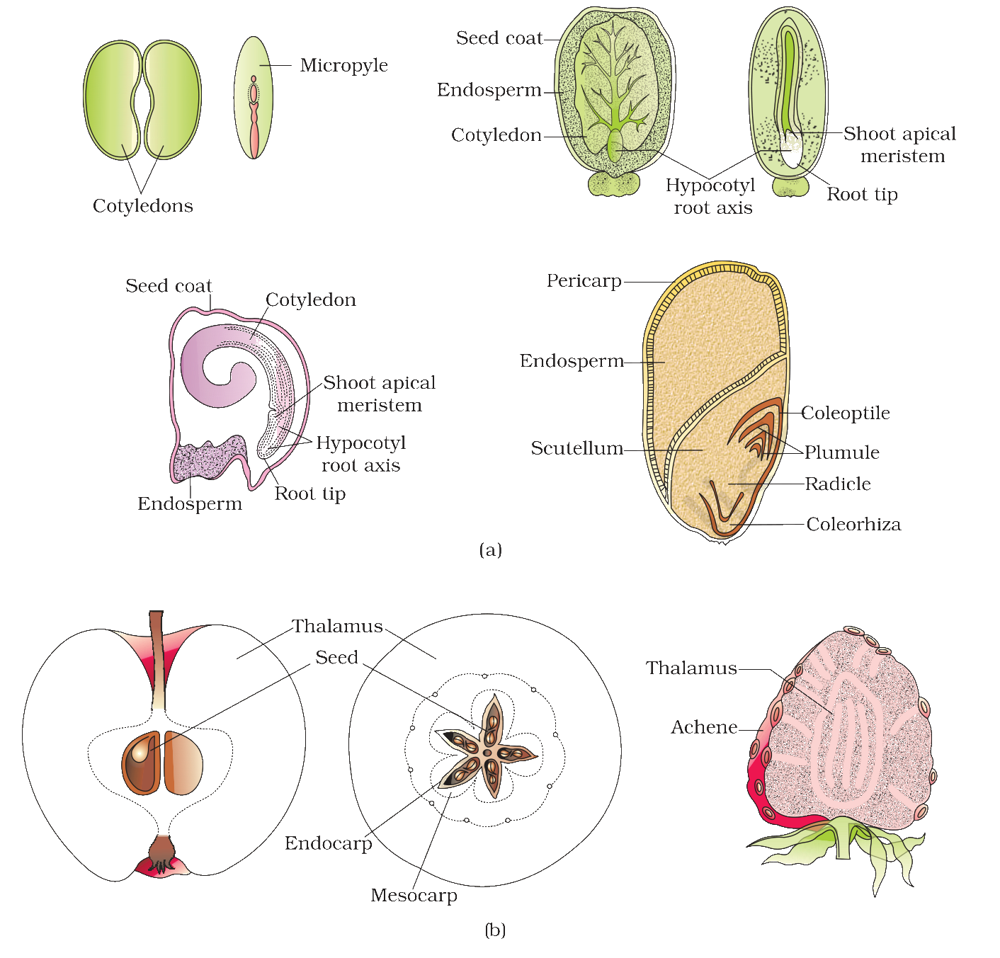
Figure 1.15 (a) Structure of some seeds. (b) False fruits of apple and strawberry