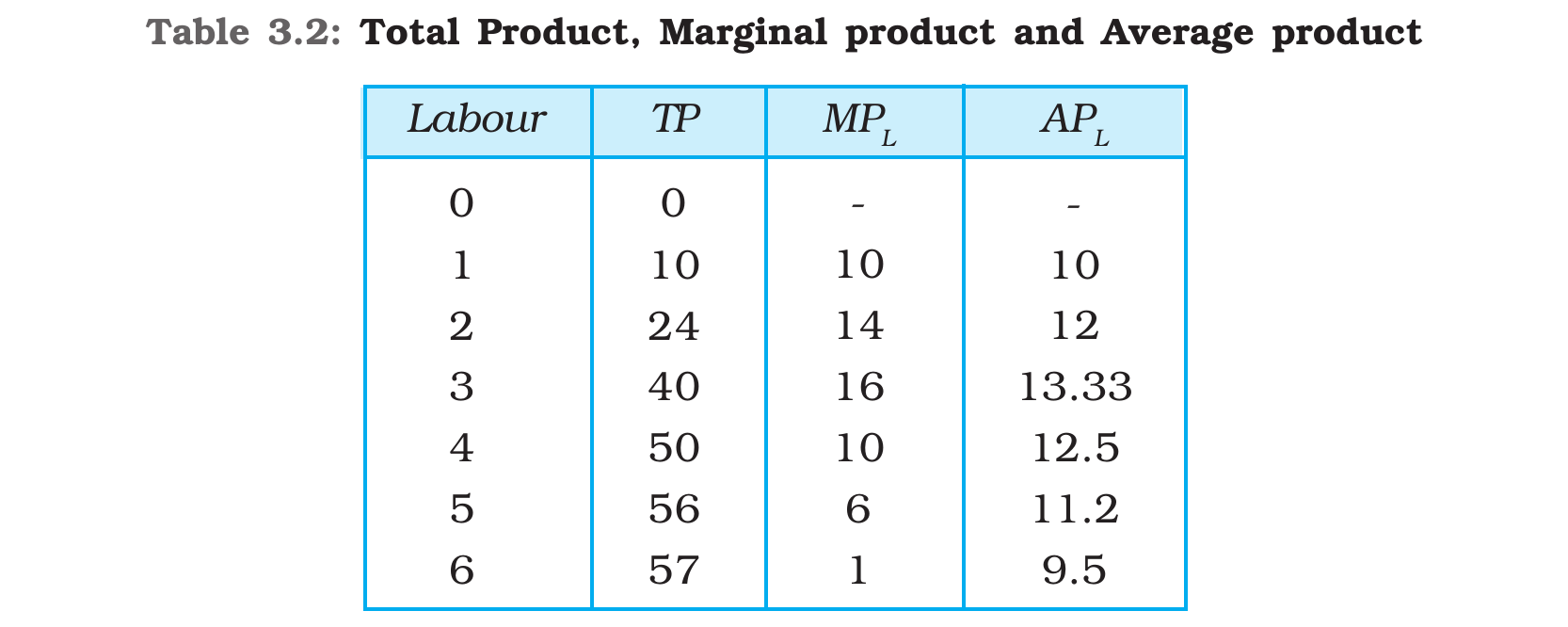
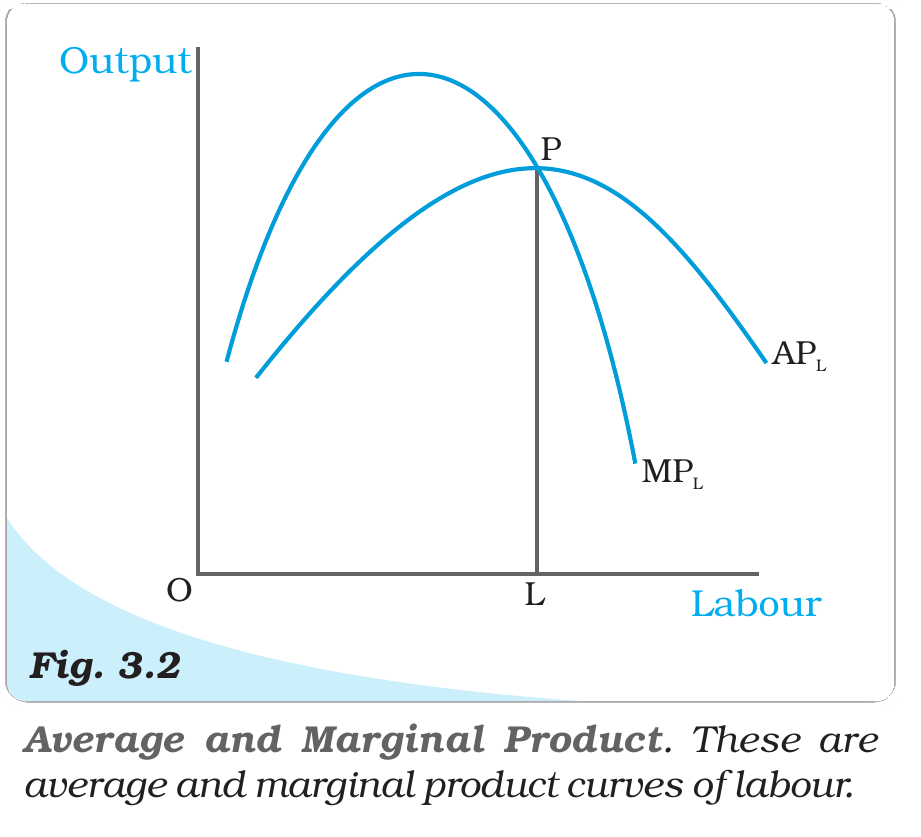
Identify the correct statements from the following:
(A) As long as MP>AP, the Average Product (AP) can rise even when the Marginal Product (MP) is falling.
(B) The law of variable proportions operates only if the factor ratio happens to change.
(C) Total Product (TP) must increase no matter if there are increasing or decreasing returns to a factor.
(D) Marginal Product (MP) = Average Product (AP), when AP is maximum.
Choose the correct answer from the options given below:
Answer & explanation
Correct answer: option 3
The correct answer is Option (3) → (A), (B), (C) and (D)
In the short run, a firm raises output by adding more of one input, say labour, to a fixed amount of the others. Total product (TP) is the total output. Marginal product (MP) is the extra output from one more unit of labour. Average product (AP) is output per unit of labour. Under the law of variable proportions, MP first rises and later falls.
(A) As long as MP>AP, the Average Product (AP) can rise even when the Marginal Product (MP) is falling. — Correct. AP is the average of all the marginal products so far. A new unit that adds more than the average pulls the average up, even if its MP is lower than that of the unit before. So AP keeps rising while MP stays above AP.
(B) The law of variable proportions operates only if the factor ratio happens to change. — Correct. The law is about one factor held fixed while the other is increased, so the ratio of the two factors keeps changing. If both rose in the same proportion, the ratio would not change; that case is returns to scale, not this law.
(C) Total Product (TP) must increase no matter if there are increasing or decreasing returns to a factor. — Correct. Increasing returns means MP is rising. Decreasing returns means MP is falling, but each extra worker still adds some output. So TP rises in both phases; only the speed of the rise changes. The TP curve slopes upward.
(D) Marginal Product (MP) = Average Product (AP), when AP is maximum. — Correct. AP rises while MP is above it and falls once MP is below it. At the maximum of AP, MP is neither above nor below AP, so the two are equal. The MP curve cuts the AP curve from above at its maximum.
NCERT (2026-27): “3.4 The Law of Diminishing Marginal Product and the Law of Variable Proportions …Let us examine what is happening to TP. Notice that TP increases as labour input increases. But the rate at which it increases is not constant.… …An increase in the amount of one of the inputs keeping all other inputs constant results in an increase in output. Table 3.2 shows how the total product changes as the amount of labour increases. The total product curve in the input-output plane is a positively sloped curve.… …Then, after a point, the MP starts falling. However, as long as the value of MP remains higher than the value of the AP, the AP continues to rise.… …It, follows that MP curve cuts AP curve from above at its maximum. Figure 3.2 shows the shapes of AP and MP curves for a typical firm. The AP of factor 1 is maximum at L.… …The law of variable proportions arises because factor proportions change as long as one factor is held constant and the other is increased.…”
|