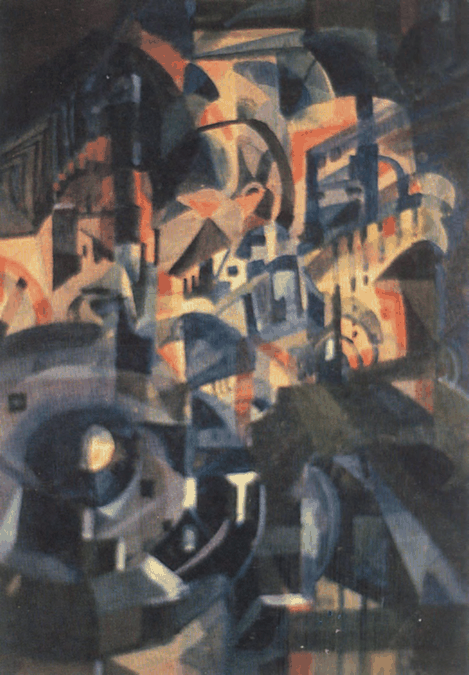
Gaganendranath Tagore used the language of Cubism in his painting City in the Night. Given below are two statements: one is labelled as Assertion (A) and the other is labelled as Reason (R).
Assertion (A): City in the Night is an oil painting.
Reason (R): In this painting, zigzag planes together create a tight formal structure.
In the light of the above statements, choose the correct answer from the options given below:
Answer & explanation
Correct answer: option 4
The correct answer is Option (4) → (A) is false but (R) is true.
Assertion (A): City in the Night is an oil painting. — False. It is a watercolour painting. Oil paint is linked in this chapter with Raja Ravi Varma, one of the first Indian painters to use it.
Reason (R): In this painting, zigzag planes together create a tight formal structure. — True. The zigzag planes together give the painting a tight formal structure.
NCERT (2026-27): “City in the Night This is a watercolour painting made by Gaganendranath Tagore (1869 –1938) in 1922. He was one of the earlier Indian painters, who made use of language and syntax of Cubism to render his ideas. …He painted an interplay of diamond-shaped planes and prismatic colours, resulting in fragmented luminosity to render the mountain ranges of the city. Zigzag planes together are able to create a tight formal structure of the painting.…”
|