
A nucleoside on hydrolysis gives
Answer & explanation
Correct answer: option 1
The correct answer is Option (1) → an aldopentose and a heterocyclic base
A nucleoside is only a base joined to a pentose sugar; it has no phosphate group. Its hydrolysis breaks only the sugar–base link and gives:
the sugar: β-D-ribose or β-D-2-deoxyribose, a five-carbon sugar with an aldehyde group, i.e. an aldopentose;
the nitrogen-containing heterocyclic base (A, G, C, T or U).
Why the other options are incorrect
Option (2) an aldopentose and an orthophosphoric acid — Incorrect. It leaves out the base and adds a phosphate, which a nucleoside does not contain.
Option (3) a heterocyclic base and an orthophosphoric acid — Incorrect. It leaves out the sugar, which is the part the base is attached to, and adds a phosphate that is not present.
Option (4) an aldopentose, a heterocyclic base and an Orthophosphoric acid — Incorrect. These three are the hydrolysis products of a nucleotide (nucleoside + phosphoric acid), not of a nucleoside.
NCERT (2026-27 edition):
10.5.1 Chemical Composition of Nucleic Acids – “Complete hydrolysis of DNA (or RNA) yields a pentose sugar, phosphoric acid and nitrogen containing heterocyclic compounds (called bases). In DNA molecules, the sugar moiety is β-D-2-deoxyribose whereas in RNA molecule, it is β-D-ribose.”
10.5.2 Structure of Nucleic Acids – “A unit formed by the attachment of a base to 1′ position of sugar is known as nucleoside. … When nucleoside is linked to phosphoric acid at 5′-position of sugar moiety, we get a nucleotide (Fig. 10.5).”
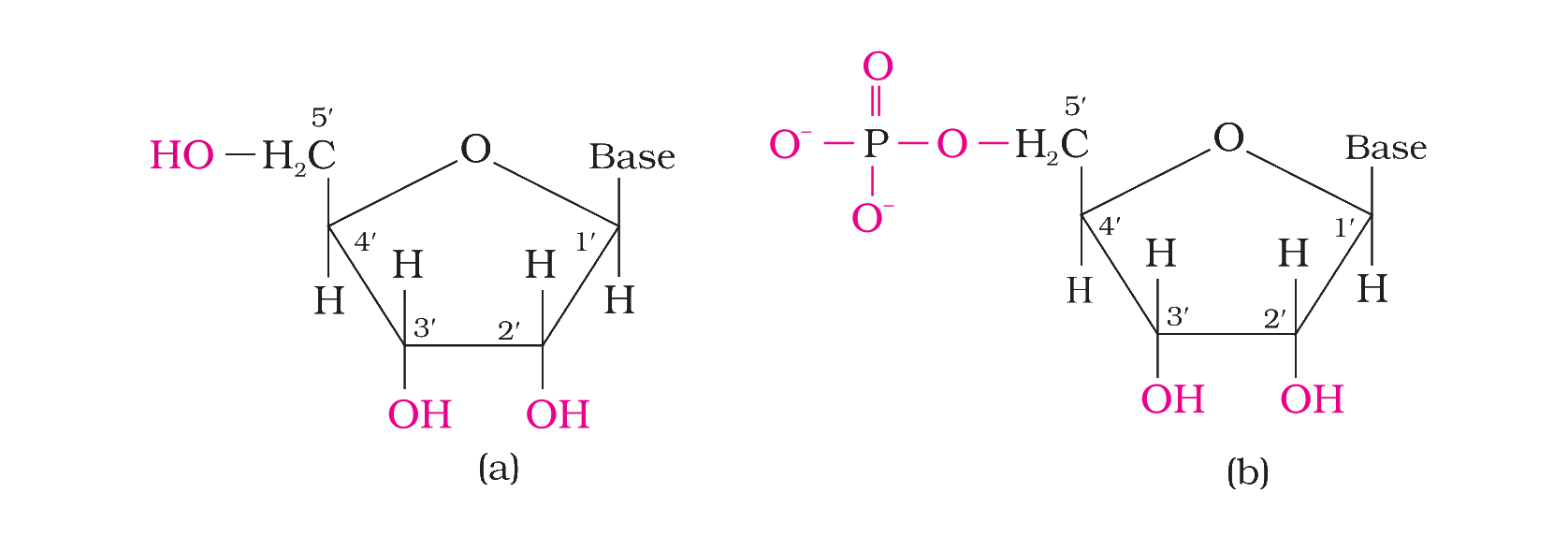
Fig. 10.5: Structure of (a) a nucleoside and (b) a nucleotide