CUETMOCK
  • Pricing
  • Mentors
Log inStart freeStart free mocks→

First test, then trust

Try a free CUET mock test.

Join 5,00,000+ students who rehearsed exam day on the exact NTA screen before sitting CUET. On the web and on Android.

Start free mocks →Get the Android app
CUETMOCK

India's #1 CUET Mock Test Platform. Original NCERT-based questions on the exact NTA exam screen — trusted by 5,00,000+ students since CUET 2022.

Get it onGoogle PlayScan to download the CUETMOCK app

Mock tests

  • CUET mock test series
  • Browse all papers
  • Commerce mocks
  • Humanities (Arts) mocks
  • Science mocks
  • Languages & GAT mocks
  • Free practice questions
  • Pricing

Resources

  • CUET exam guide
  • CUET syllabus
  • Universities accepting CUET
  • Expert blogs
  • News & notifications
  • Webinars & counselling
  • CUET score calculator
  • How we estimate your rank
  • FAQs

Company

  • About us
  • Our leadership & team
  • Our toppers
  • Mentors
  • For schools
  • Contact us
  • Terms
  • Privacy
  • Refund policy

Talk to us

+91 7696 6630 56info@cuetmock.comWhatsApp us

Our other platforms

  • JEE Mock — For IIT-JEE aspirants
  • NEET Mock — For NEET aspirants

Newsletter

Exam updates, study material and offers — no spam.

© 2026 NYC Ventures Pvt. Ltd.

701-702, Royal Business Park, Zirakpur, Punjab - 140603

  • Terms of use
  • Privacy policy
  • Refund policy
  • Contact us

iCUETMOCK is an independent preparation platform, not affiliated with the National Testing Agency (NTA). Always check exam details on the official NTA website.

  • Home
  • Mock tests
  • CUET guide
  • Pricing
  • Log in
Home/Practice questions/Political Science
Political ScienceContemporary World Politics: Contemporary Centres of power

Two founder members of ASEAN are:

Two founder members of ASEAN are:

Answer & explanation+

Correct answer: option 2

The correct answer is Option (2) → Indonesia and Malaysia

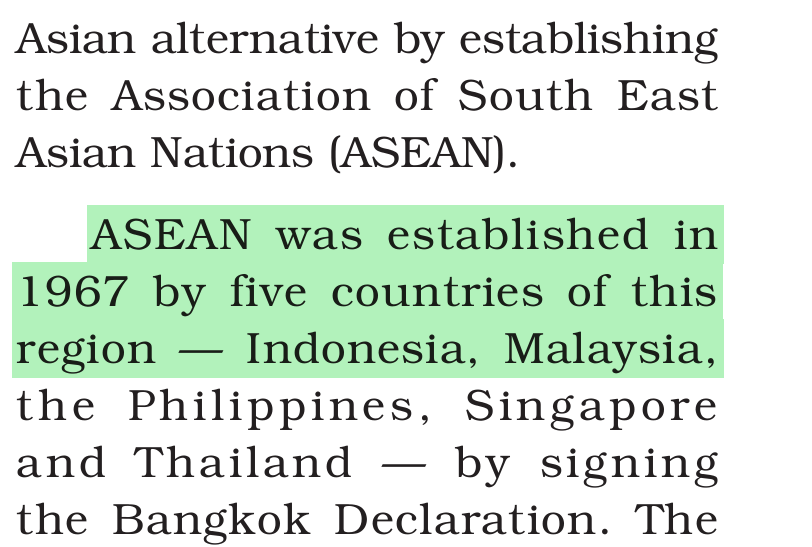
ASEAN was established in 1967 by five countries – Indonesia, Malaysia, the Philippines, Singapore and Thailand – by signing the Bangkok Declaration.


NCERT (2026-27): Contemporary World Politics — Chapter 2: Contemporary Centres of Power

NCERT extract

Advertisement

Practise more on Contemporary World Politics: Contemporary Centres of power

Chapter-wise mocks on the real NTA exam screen, with solutions and your rank. Your first mocks are free.

Start free mocks →

Advertisement

Next questions

  1. The age-group pyramid shows males and females separately for each five-year age group. What does this make it, compared with the age-groupe…Sociology · Indian Society: Demographic Structure of Indian Society
  2. What is the value of 100^2-99^2+98^2-97^2+96^2-95^2+94^2-93^2+..... 12^2-11^2 ?General Aptitude Test · Quantitative Reasoning
  3. __________social movements attempt to radically transform social relations, often by capturing state power.Sociology · Social Change and Development in India: Social Movements
  4. Given the following set of data calculate equilibrium income.C = 100 + 0.8 y.Investment = ₹ 260 Cr.Economics · Macro Economics: Determination of Income and Employment
  5. Rearrange the given parts in the correct sequence to form a meaningful sentence:- (A) hot desert in the entire world(B) covering approximat…English · Arrange in Meaningful Sequence
  6. Which one of the following diagram best depicts the relationship between Boys ,Students, AthaleteGeneral Aptitude Test · Verbal Reasoning
  7. A dishonest shopkeeper promises to sell his goods at its cost price but he uses 24% less weight. The profit percent is:General Aptitude Test · Numerical Ability
  8. Given below are four jumbled sentences. Select the option that gives their correct order. A. “Today, respect is shown in different ways,” s…English · Arrange in Meaningful Sequence
  9. Which of the following is not associated with the coupling reaction of benzene diazonium chloride?Chemistry · Organic: Amines
  10. Which of the following pairs is correctly matched? List-IList-II1. Average propensity to consumeA. Change in consumption per unit change in…Economics · Macro Economics: Determination of Income and Employment