
Which of the following diagram correctly shows the electrostatic properties of a charged conductor. (Given \( V_o \) potential on the surface of conductor, \( \rho \) = Volume charge density.)
Answer & explanation
Correct answer: option 3
The correct answer is Option (3)
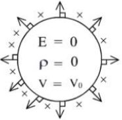
In electrostatic equilibrium a charged conductor has these properties:
The electric field inside is zero, \( E = 0 \); otherwise the free charges would keep moving.
There is no charge inside, \( \rho = 0 \); the excess charge resides on the surface.
The potential is the same everywhere inside and equal to its value on the surface, \( V = V_0 \), because \( E = 0 \) means no change of potential.
Just outside, the field lines are normal to the surface at every point.
The figure of Option (3) shows \( E = 0 \), \( \rho = 0 \), \( V = V_0 \) and field lines leaving the surface at right angles (the small square marks).
Why the other options are incorrect
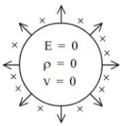
Option (1) — Incorrect. The potential inside is marked \( V = 0 \); it must equal the surface potential \( V_0 \), which is not zero for a charged conductor.
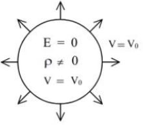
Option (2) — Incorrect. It shows \( \rho \ne 0 \); a conductor in equilibrium has no charge inside, only on its surface.
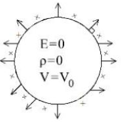
Option (4) — Incorrect. The field lines leave the surface at a slant; they must be normal to the surface of a conductor.
NCERT (2026-27):
Summary – “… 8. Electrostatics field E is zero in the interior of a conductor; just outside the surface of a charged conductor, E is normal to the surface given by
\( \displaystyle \mathbf{E} = \frac{\sigma}{\varepsilon_0}\,\hat{\mathbf{n}} \)
… Charges in a conductor can reside only at its surface. Potential is constant within and on the surface of a conductor.”