
Gabriel synthesis is used for the synthesis of
Answer & explanation
Correct answer: option 2
The correct answer is Option (2) → Primary amines
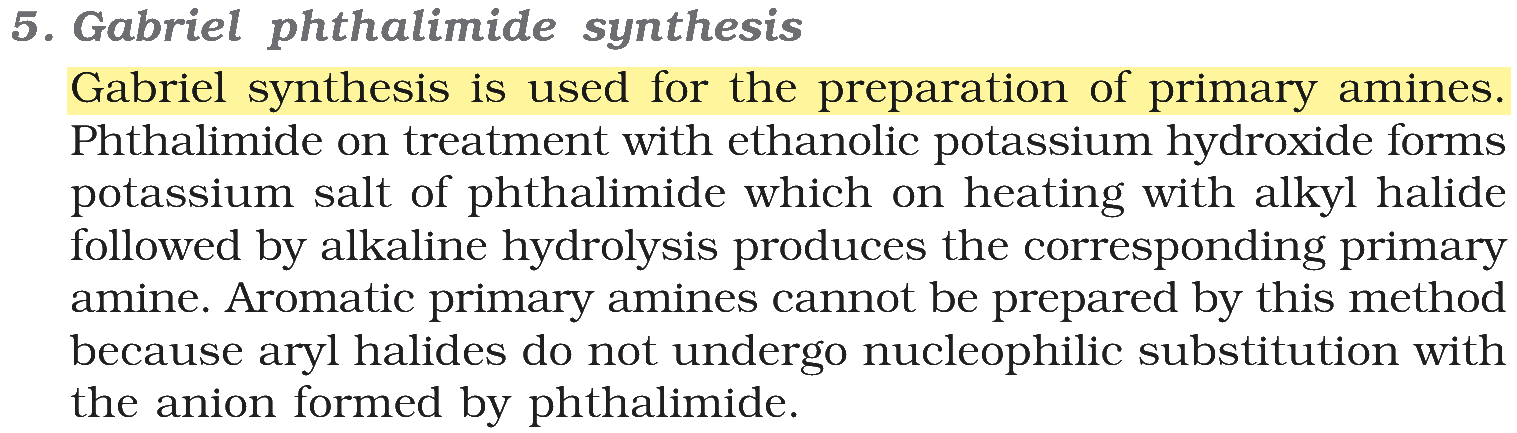
In the Gabriel phthalimide synthesis, the N–H hydrogen of phthalimide is acidic because the nitrogen is flanked by two C=O groups. Ethanolic KOH removes it, and the phthalimide anion is alkylated by an alkyl halide. Since nitrogen then carries no hydrogen, it cannot be alkylated a second time. Alkaline hydrolysis finally releases the amine:
\( \displaystyle \ce{C6H4(CO)2NH + KOH} \xrightarrow{\text{ethanol}} \ce{C6H4(CO)2N^-K+ + H2O} \)
\( \displaystyle \ce{C6H4(CO)2N^-K+ + R-X -> C6H4(CO)2N-R + KX} \)
\( \displaystyle \ce{C6H4(CO)2N-R + 2NaOH(aq) -> R-NH2 + C6H4(COONa)2} \)
So the method gives a pure primary amine, free from secondary and tertiary amines. Aryl halides do not react with the phthalimide anion, so aromatic primary amines such as aniline cannot be made this way.
Why the other options are incorrect
Option (1) Carboxylic acids — Incorrect. The phthalic acid part ends up only as its sodium salt, a by-product; the alkyl group of the halide is released bonded to –\( \ce{NH2} \).
Option (3) Alcohols — Incorrect. The alkyl group is attached to the nitrogen of phthalimide, so hydrolysis releases R–\( \ce{NH2} \), not R–OH.
Option (4) Aldehydes — Incorrect. There is no oxidation step and no C=O group is formed on the alkyl chain; the product is an amine.
NCERT (2026-27 edition):
Gabriel Phthalimide Synthesis
Note: The same/similar question has been asked in different years by NTA as per the details given below:
| 2026 | 2025 | 2024 | 2023 | 2022 |
|---|---|---|---|---|
| – | 02-06 S1 16-05 S1 13-05 S1 | – | 11-06 S3 | – |