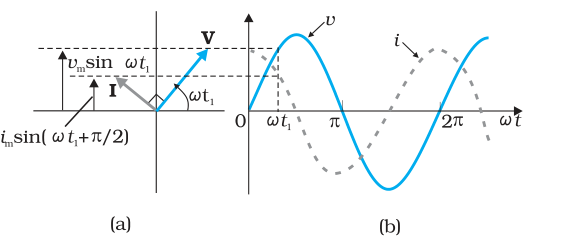
If a capacitor is connected in an ac circuit, what is the phase relationship between current and potential difference applied across the capacitor?
Answer & explanation
Correct answer: option 1
The correct answer is Option (1) → The current leads the potential difference by \( \pi/2 \)
The current in a capacitor is the rate at which its charge changes, \( i = \frac{dq}{dt} = C\frac{dv}{dt} \). For an applied voltage \( v = v_m\sin\omega t \):
\( \displaystyle i = C\frac{d}{dt}\left(v_m\sin\omega t\right) = \omega Cv_m\cos\omega t = i_m\sin\left(\omega t + \frac{\pi}{2}\right) \)
So the current reaches its maximum a quarter of a period before the voltage: it leads the voltage by \( \pi/2 \).
NCERT (2026-27):
AC Voltage Applied to a Capacitor – “… A comparison of Eq. (7.16) with the equation of source voltage, Eq. (7.1) shows that the current is \( \pi/2 \) ahead of voltage.”