
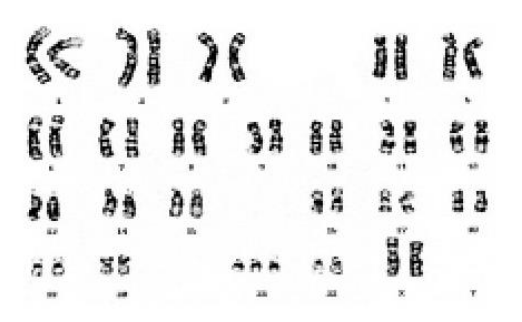
The chromosomal disorders are caused due to absence, excess or abnormal arrangement of one or more chromosomes. Failure of segregation of chromatids during cell division results in the gain or loss of chromosome(s), called aneuploidy.
The disorder shown in figure can occur in human __________.
Answer & explanation
Correct answer: option 3
The correct answer is Option (3) → Irrespective of Gender (male or female)
The extra chromosome is an autosome (chromosome 21), not a sex chromosome, so Down’s syndrome is seen in both males and females.
Option (1) Males — Incorrect. Down’s syndrome comes from an extra chromosome 21, an autosome. Since autosomes are present in both sexes, it is not limited to males.
Option (2) Females — Incorrect. The extra chromosome is an autosome (21), not a sex chromosome. So the disorder is not limited to females; it occurs in both sexes.
Option (3) Irrespective of Gender (male or female) — Correct. The figure shows a disorder of an autosome (chromosome 21), not of a sex chromosome. Autosomes are the same in males and females, so the disorder can occur irrespective of gender.
Option (4) Suffering with haemophilia — Incorrect. Haemophilia is a separate, sex-linked single-gene disorder. Down’s syndrome is caused by trisomy 21 and does not depend on whether a person has haemophilia.