Which of the following conditions can be used to change physical adsorption of a gas to chemical adsorption?
Answer & explanation
Correct answer: option 2
The correct answer is Option (2) → Increase in temperature
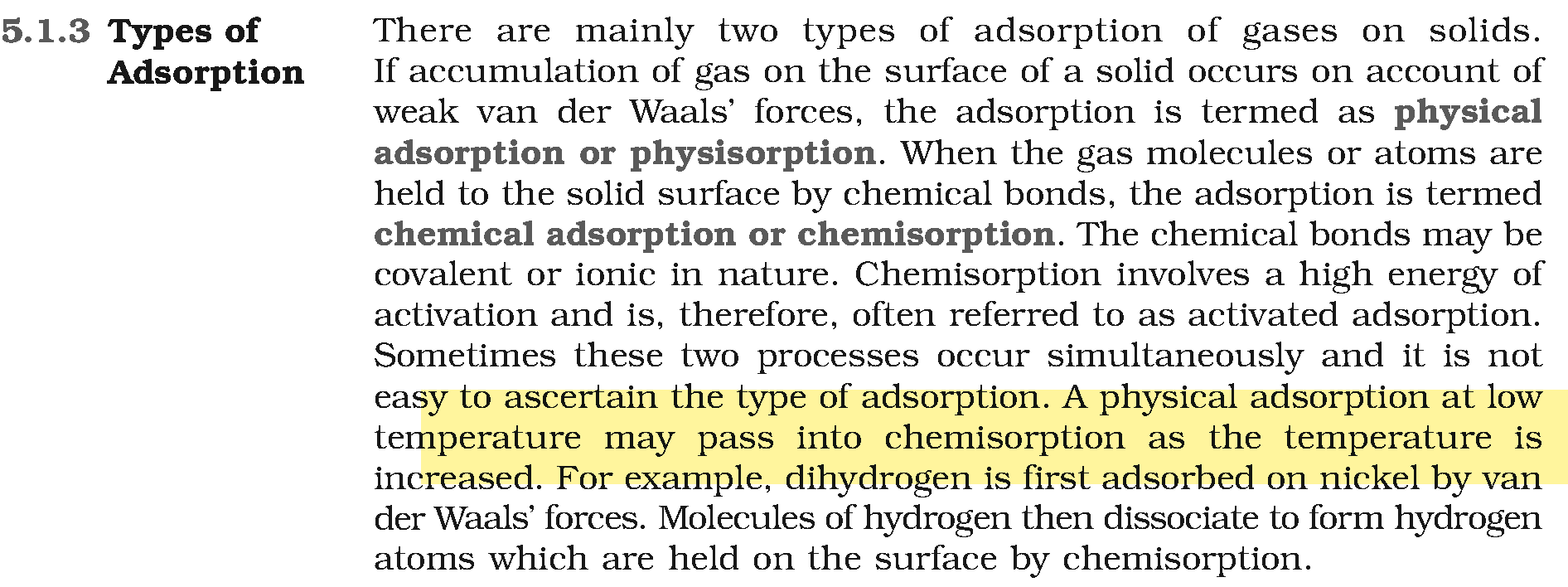
Chemisorption needs chemical bonds to form, so like a chemical reaction it needs activation energy. Raising the temperature supplies this energy, so a gas held by van der Waals forces at low temperature becomes chemically bonded as the temperature rises, as with \( \ce{H2} \) on nickel:
\( \displaystyle \ce{H2} \text{ (physisorbed on Ni)} \xrightarrow{\text{higher } T} 2\,\ce{H} \text{ (chemisorbed on Ni)} \)
Why the other options are incorrect
Option (1) Decrease in temperature — Incorrect. Physisorption itself increases at lower temperature; it does not turn into chemisorption.
Option (3) Using catalyst — Incorrect. A catalyst speeds up a reaction; it does not decide whether a gas is held by van der Waals forces or by chemical bonds.
Option (4) Increasing surface area of adsorbent — Incorrect. It increases the extent of adsorption of both kinds, but not its type.
Note: This question is from the pre-rationalised NCERT book (2022-23). The topic is not there in the latest NCERT book (2026-27), and it is also out of the CUET 2026 syllabus.
NCERT (Pre-rationalised edition, 2022-23):
Types of Adsorption