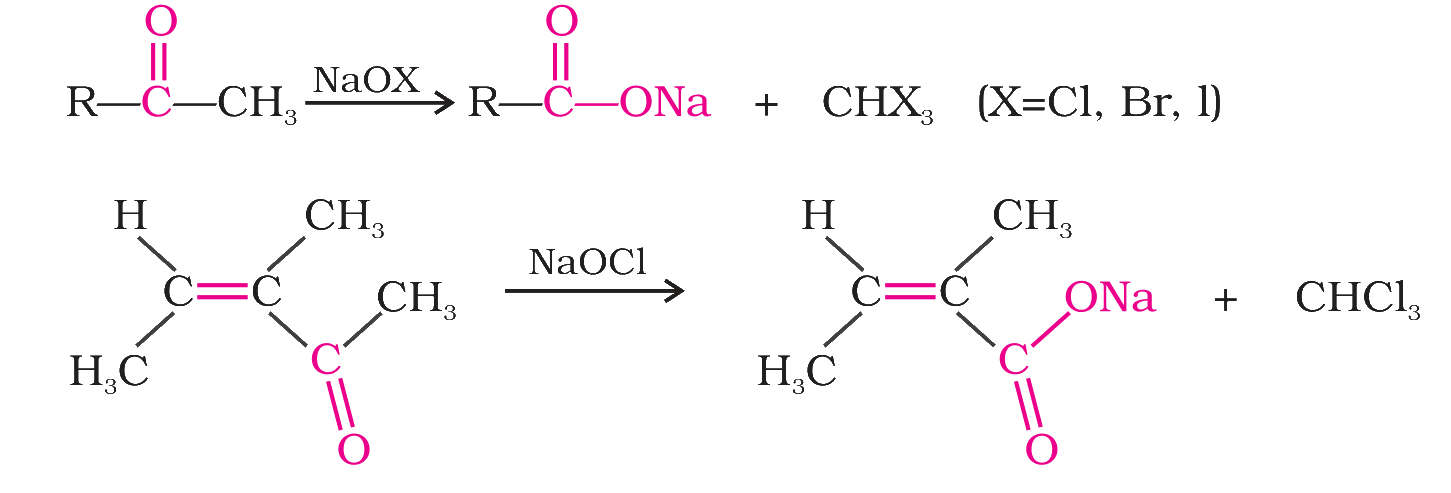
3-Methylpent-3-en-2-one, \( \ce{CH3CH=C(CH3)COCH3} \), is treated with sodium hypochlorite. Which of the following sodium salts is formed in this reaction?
Answer & explanation
Correct answer: option 4
The correct answer is Option (4) → Sodium 2-methylbut-2-enoate
3-Methylpent-3-en-2-one is a methyl ketone (a CH3 group is joined to the carbonyl carbon), so sodium hypochlorite oxidises it by the haloform reaction. The CH3 group leaves as chloroform, and the rest becomes the sodium salt of an acid with one carbon atom less. The C=C bond is not affected:
\( \displaystyle \ce{CH3CH=C(CH3)COCH3 + 3NaOCl -> CH3CH=C(CH3)COONa + CHCl3 + 2NaOH} \)
The salt CH3CH=C(CH3)COONa has four carbons in its main chain, the C=C bond at C-2 and a methyl group at C-2: sodium 2-methylbut-2-enoate.
Why the other options are incorrect
Option (1) Sodium 2-methylbutanoate — Incorrect. This salt is saturated; it has lost the C=C bond. The haloform oxidation does not affect a C=C bond, and nothing in the reaction reduces it.
Option (2) Sodium 3-methylpent-3-enoate — Incorrect. This salt has five carbons, as many as the ketone. The methyl group leaves as CHCl3, so the acid has one carbon atom less.
Option (3) Sodium 2,3-dichloro-2-methylbutanoate — Incorrect. This salt has chlorine added across the C=C bond. The chlorine of the hypochlorite ends up only in chloroform; the C=C bond is not attacked.
NCERT (2026-27 edition):
8.4 Chemical Reactions – “(iii) Oxidation of methyl ketones by haloform reaction: Aldehydes and ketones having at least one methyl group linked to the carbonyl carbon atom (methyl ketones) are oxidised by sodium hypohalite to sodium salts of corresponding carboxylic acids having one carbon atom less than that of carbonyl compound. The methyl group is converted to haloform. This oxidation does not affect a carbon-carbon double bond, if present in the molecule.”