Match List - I with List - II.
| List - I | List - II |
| (A) Conductance | (I) \( [ML^{3}T^{-3}A^{-2}] \) |
| (B) Current density | (II) \( [M^{-1}L^{-3}T^{3}A^{2}] \) |
| (C) Specific resistance | (III) \( [M^{0}L^{-2}T^{0}A^{1}] \) |
| (D) Electrical conductivities | (IV) \( [M^{-1}L^{-2}T^{3}A^{2}] \) |
Choose the correct answer from the options given below:
Answer & explanation
Correct answer: option 4
The correct answer is Option (4) → (A)-(IV), (B)-(III), (C)-(I), (D)-(II)
All four quantities are built from the dimensions of resistance. Potential difference is work per unit charge, and resistance is potential difference per unit current:
\( \displaystyle [V] = \frac{[ML^{2}T^{-2}]}{[AT]} = [ML^{2}T^{-3}A^{-1}] \)
\( \displaystyle [R] = \frac{[V]}{[A]} = [ML^{2}T^{-3}A^{-2}] \)
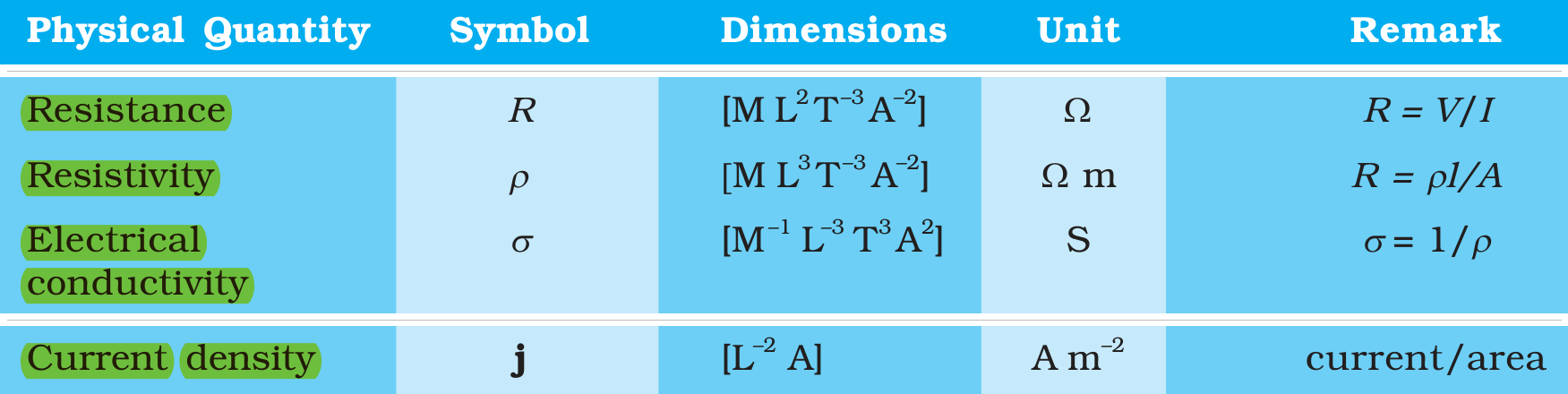
(A) Conductance — this matches (IV) \( [M^{-1}L^{-2}T^{3}A^{2}] \). Conductance is the reciprocal of resistance, \( G = 1/R \), so every power of \( [R] \) changes sign.
(B) Current density — this matches (III) \( [M^{0}L^{-2}T^{0}A^{1}] \). Current density is current per unit area, \( j = I/A \), with unit \( \mathrm{A\,m^{-2}} \).
(C) Specific resistance — this matches (I) \( [ML^{3}T^{-3}A^{-2}] \). Specific resistance (resistivity) is \( \rho = RA/l \), so it has one more power of length than resistance.
\( \displaystyle [\rho] = [ML^{2}T^{-3}A^{-2}] \times \frac{[L^{2}]}{[L]} = [ML^{3}T^{-3}A^{-2}] \)
(D) Electrical conductivities — this matches (II) \( [M^{-1}L^{-3}T^{3}A^{2}] \). Conductivity is the reciprocal of resistivity, \( \sigma = 1/\rho \), so the powers of \( [\rho] \) change sign.
Note: A similar question was also asked in CUET (UG) 2023 on 09-06-2023 (Slot 3).
NCERT (2026-27):
Summary – …