
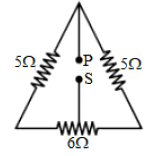
Three resistances \( 5\,\Omega \), \( 5\,\Omega \) and \( 6\,\Omega \) are connected as shown in the figure. If the point S divides the \( 6\,\Omega \) resistance into two equal halves, the resistance between the points P and S is
Answer & explanation
Correct answer: option 4
The correct answer is Option (4) → \( 4\,\Omega \)
Resistors joined end to end with the same current form a series combination. Two paths between the same pair of points form a parallel combination.
From the figure, P is joined to the top corner where the two \( 5\,\Omega \) resistors meet. S is at the middle of the \( 6\,\Omega \) resistor, so it divides this resistor into two halves of \( 3\,\Omega \) each.
Between P and S there are two paths:
through the left \( 5\,\Omega \) resistor and the left half of the \( 6\,\Omega \) resistor, \( 5\,\Omega+3\,\Omega=8\,\Omega \) in series
through the right \( 5\,\Omega \) resistor and the right half of the \( 6\,\Omega \) resistor, \( 5\,\Omega+3\,\Omega=8\,\Omega \) in series
The two \( 8\,\Omega \) paths are in parallel between P and S:
\( \begin{aligned} \frac{1}{R_{\mathrm{PS}}} &= \frac{1}{8\,\Omega}+\frac{1}{8\,\Omega} \\ &= \frac{1}{4\,\Omega} \end{aligned} \)
\( R_{\mathrm{PS}}=4\,\Omega \)