CUETMOCK
  • Pricing
  • Mentors
Log inStart freeStart free mocks→

First test, then trust

Try a free CUET mock test.

Join 5,00,000+ students who rehearsed exam day on the exact NTA screen before sitting CUET. On the web and on Android.

Start free mocks →Get the Android app
CUETMOCK

India's #1 CUET Mock Test Platform. Original NCERT-based questions on the exact NTA exam screen — trusted by 5,00,000+ students since CUET 2022.

Get it onGoogle PlayScan to download the CUETMOCK app

Mock tests

  • CUET mock test series
  • Browse all papers
  • Commerce mocks
  • Humanities (Arts) mocks
  • Science mocks
  • Languages & GAT mocks
  • Free practice questions
  • Pricing

Resources

  • CUET exam guide
  • CUET syllabus
  • Universities accepting CUET
  • Expert blogs
  • News & notifications
  • Webinars & counselling
  • CUET score calculator
  • How we estimate your rank
  • FAQs

Company

  • About us
  • Our leadership & team
  • Our toppers
  • Mentors
  • For schools
  • Contact us
  • Terms
  • Privacy
  • Refund policy

Talk to us

+91 7696 6630 56info@cuetmock.comWhatsApp us

Our other platforms

  • JEE Mock — For IIT-JEE aspirants
  • NEET Mock — For NEET aspirants

Newsletter

Exam updates, study material and offers — no spam.

© 2026 NYC Ventures Pvt. Ltd.

701-702, Royal Business Park, Zirakpur, Punjab - 140603

  • Terms of use
  • Privacy policy
  • Refund policy
  • Contact us

iCUETMOCK is an independent preparation platform, not affiliated with the National Testing Agency (NTA). Always check exam details on the official NTA website.

  • Home
  • Mock tests
  • CUET guide
  • Pricing
  • Log in
Home/Practice questions/History
HistoryAncient India: Thinkers, Beliefs and Buildings

Identify the people who were part of the debates of Buddha's teaching…

Read the passage and answer the questions:

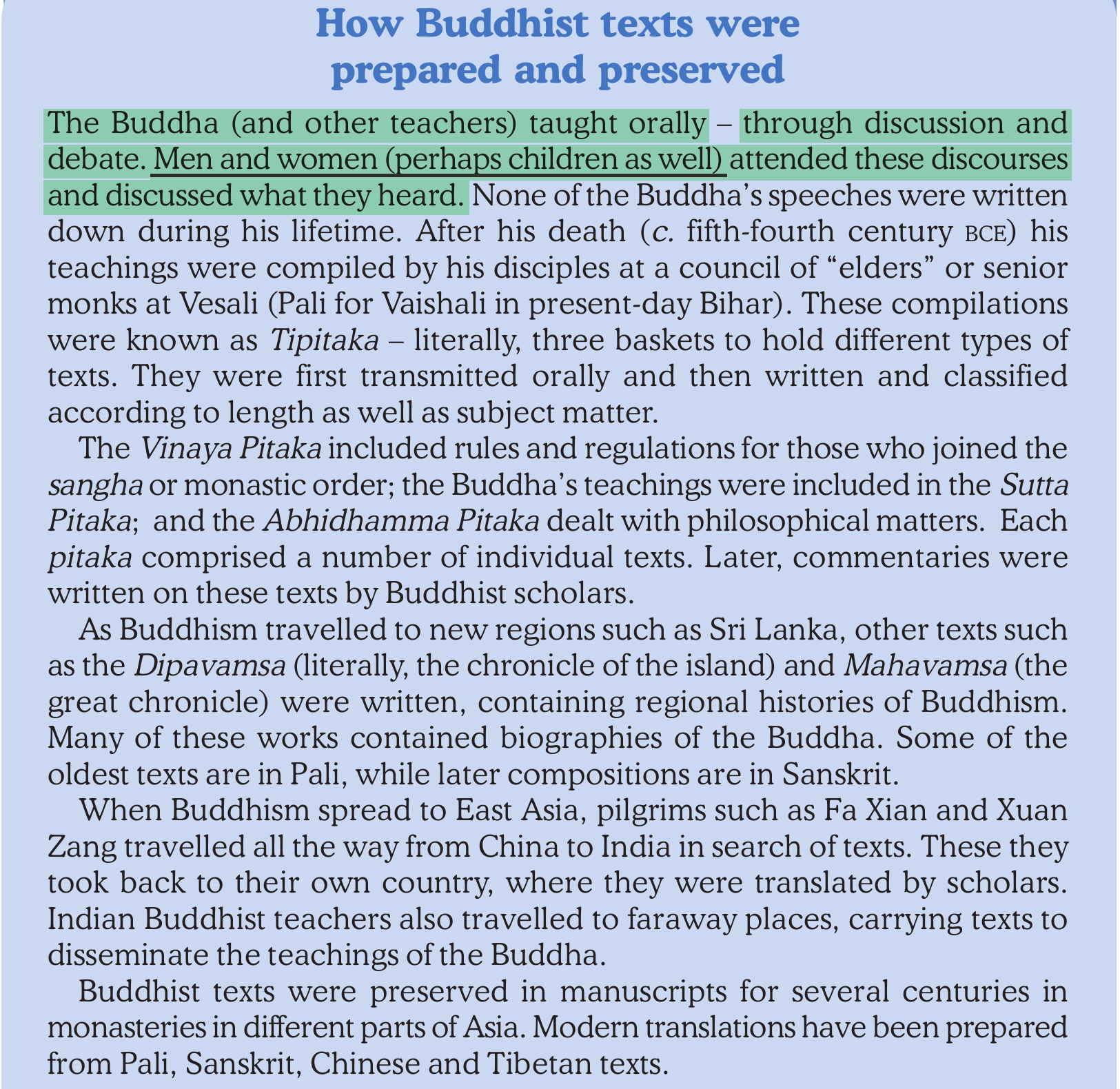
The Buddha (and other teachers) taught orally through discussion and debate. Men and women (perhaps children as well) attended these discourses and discussed what they heard. None of the Buddha's speeches were written down during his lifetime. After his death (c. fifth-fourth century BCE) his teachings were compiled by his disciples at a council of "elders" or senior monks at Vesali (Pali for Vaishali in present-day Bihar). These compilations were known as Tipitaka - literally, three baskets to hold different types of texts. They were first transmitted orally and then written and classified according to length as well as subject matter.

The Vinaya Pitaka included rules and regulations for those who joined the sangha or monastic order; the Buddha's teachings were included in the Sutta Pitaka; and the Abhidhamma Pitaka dealt with philosophical matters. Each pitaka comprised a number of individual texts. Later, commentaries were written on these texts by Buddhist scholars.

As Buddhism travelled to new regions such as Sri Lanka, other texts such as the Dipavamsa (literally, the chronicle of the island) and Mahavamsa (the great chronicle) were written, containing regional histories of Buddhism. Many of these works contained biographies of the Buddha. Some of the oldest texts are in Pali, while later compositions are in Sanskrit.

When Buddhism spread to East Asia, pilgrims such as Fa Xian and Xuan Zang travelled all the way from China to India in search of texts. These they took back to their own country, where they were translated by scholars. Indian Buddhist teachers also travelled to faraway places, carrying texts to disseminate the teachings of the Buddha.

Buddhist texts were preserved in manuscripts for several centuries in monasteries in different parts of Asia. Modern translations have been prepared from Pali, Sanskrit, Chinese and Tibetan texts.

Identify the people who were part of the debates of Buddha's teachings.

Answer & explanation+

Correct answer: option 3

The correct answer is Option (3) → Men and women (perhaps children as well)

The Buddha taught orally, through discussion and debate, and men and women, perhaps children as well, attended these discourses and discussed what they heard.


NCERT: Themes in Indian History Part I — Chapter 4: Thinkers, Beliefs and Buildings (2026-27)

NCERT extract

Advertisement

Practise more on Ancient India: Thinkers, Beliefs and Buildings

Chapter-wise mocks on the real NTA exam screen, with solutions and your rank. Your first mocks are free.

Start free mocks →

Advertisement

Next questions

  1. If 10 percent per annum rate of compound interest compounded yearly is equivalent to the x percent per annum rate of compound interest comp…General Aptitude Test · Numerical Ability
  2. In Rutherford's Alpha Scattering experiment, passage of most alpha particles through the gold foil shows which of the following?Physics · Atoms
  3. The technique of the painting "Tiller of Soil" is:Fine Arts · The Bengal School and Cultural Nationalism
  4. "I will call you tomorrow."English · Grammar: Adverb
  5. In a partnership firm, there are partners A, B and C, sharing profits in the ratio 3:2:1. A retires, and after all adjustments, the Capital…Accountancy Part A · Reconstitution of Partnership Firm: Retirement and Death
  6. The angles of a triangle are in the ratio of 2 : 6 : 2. The triangle is:General Aptitude Test · Quantitative Reasoning
  7. What does "the sands o' life" signify in the above extract?English · Comprehension - (Poetry / Literary)
  8. Calculate the current account balances of A and B respectively.Accountancy Part A · Admission of a Partner
  9. Select the option that can be used as a one-word substitute for the given group of words. A journey undertaken by a group of people with a…English · One Word
  10. In a circle two equal and parallel chords are 6 cm apart and lie on the opposite sides of the centre of the circle. If the length of each c…General Aptitude Test · Quantitative Reasoning