
Match List I with List II
|
List I (Ions) |
List II Magnetic Moment (BM) |
| A. \(V^{2+}\) | I. 1.73 |
| B. \(Ni^{2+}\) | II. 3.87 |
| C. \(Cu^{2+}\) | III. 4.90 |
| D. \(Cr^{2+}\) | IV. 2.84 |
Choose the correct answer from the options given below:
Answer & explanation
Correct answer: option 1
The correct answer is option 1. A-II, B-IV, C-I, D-III.
|
List I (Ions) |
List II Magnetic Moment (BM) |
| A. \(V^{2+}\) | II. 3.87 |
| B. \(Ni^{2+}\) | IV. 2.84 |
| C. \(Cu^{2+}\) | I. 1.73 |
| D. \(Cr^{2+}\) | III. 4.90 |
A. \(V^{2+}\):
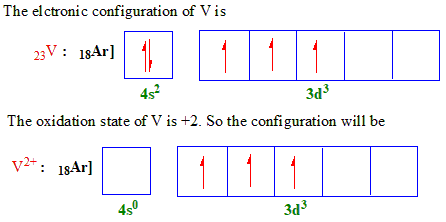
Number of unpaired electrons = 3
So the magnetic moment will be
\(\mu = \sqrt{n (n + 2)}\)
or, \(\mu = \sqrt{3 (3 + 2)}\)
or, \(\mu =\sqrt{15}\)
or, \(\mu = 3.87\)
Which matches with II from List II.
B. \(Ni^{2+}\)
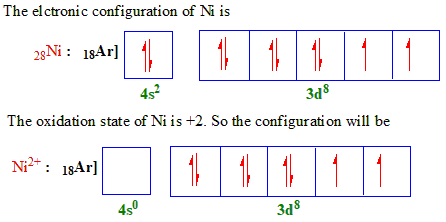
Number of unpaired electrons = 2
So the magnetic moment will be
\(\mu = \sqrt{2 (2 + 2)}\)
or, \(\mu =\sqrt{8}\)
or, \(\mu = 2.84\)
Which matches with IV from List II.
C. \(Cu^{2+}\)
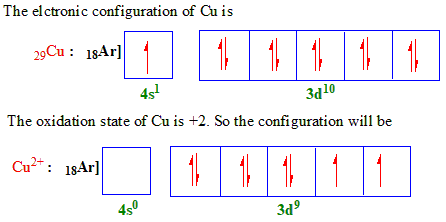
Number of unpaired electrons = 1
So the magnetic moment will be
\(\mu = \sqrt{1 (1 + 2)}\)
or, \(\mu =\sqrt{5}\)
or, \(\mu = 1.73\)
Which matches with I from List II.
D. \(Cr^{2+}\)
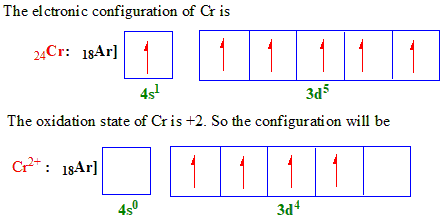
Number of unpaired electrons = 4
So the magnetic moment will be
\(\mu = \sqrt{4 (4 + 2)}\)
or, \(\mu =\sqrt{24}\)
or, \(\mu = 4.90\)
Which matches with III from List II.