Arrange the following complex ions in increasing order of their wavelength of light absorbed:
(A) [Co(CN)6]3−
(B) [Co(NH3)6]3+
(C) [CoF6]3−
(D) [Co(C2O4)]3−
Choose the correct answer from the options given below:
Answer & explanation
Correct answer: option 1
The correct answer is Option (1) → (A), (B), (D), (C)
In an octahedral complex the ligands split the d orbitals into two sets separated by the crystal field splitting energy, Δo. The colour of the complex comes from an electron jumping across this gap, so the energy of the light absorbed equals Δo:
\( \displaystyle \Delta_o=\frac{hc}{\lambda} \Rightarrow \lambda=\frac{hc}{\Delta_o} \)
So a larger Δo means light of shorter wavelength is absorbed.
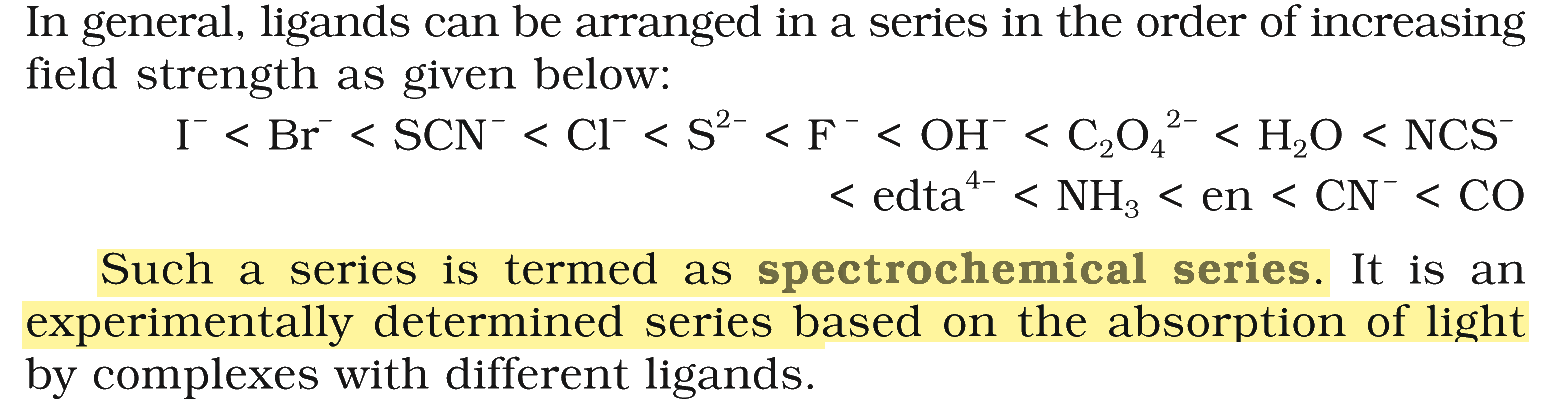
All four complexes contain Co(III), so Δo depends only on the ligand. Ligands are arranged by the size of the splitting they produce in the spectrochemical series.
For the given ligands:
Δo: \( \ce{CN^{-}} \) > \( \ce{NH3} \) > \( \ce{C2O4^{2-}} \) > \( \ce{F^{-}} \)
wavelength absorbed: \( \ce{CN^{-}} \) < \( \ce{NH3} \) < \( \ce{C2O4^{2-}} \) < \( \ce{F^{-}} \)
Matching the given complexes:
(A) \( \ce{[Co(CN)6]^{3-}} \): strongest field ligand, shortest wavelength
(B) \( \ce{[Co(NH3)6]^{3+}} \): strong field ligand
(D) \( \ce{[Co(C2O4)3]^{3-}} \): weaker than \( \ce{NH3} \)
(C) \( \ce{[CoF6]^{3-}} \): weakest field ligand, longest wavelength
Shortcut: Options (1) and (2) both start with (A) and end with (C). \( \ce{NH3} \) is a stronger ligand than oxalate, so (B) comes before (D), which leaves only Option (1).
Note: It seems that there is a mistake in the original NTA paper, which prints [Co(C2O4)]3− in (D) when it should read [Co(C2O4)3]3−.
NCERT (2026-27 edition):
Crystal Field Theory – …