Consider the following reaction and choose the correct statements corresponding to the reaction.
R/Ar–NH2 + 3KOH + CHCl3 → R/Ar–NC + 3KCl + 3H2O
(A) carbylamine reaction.
(B) isocyanide test.
(C) used as a test for primary amines.
(D) used as a test for secondary amines.
Choose the correct answer from the options given below:
Answer & explanation
Correct answer: option 3
The correct answer is Option (3) → (A), (B) and (C) only
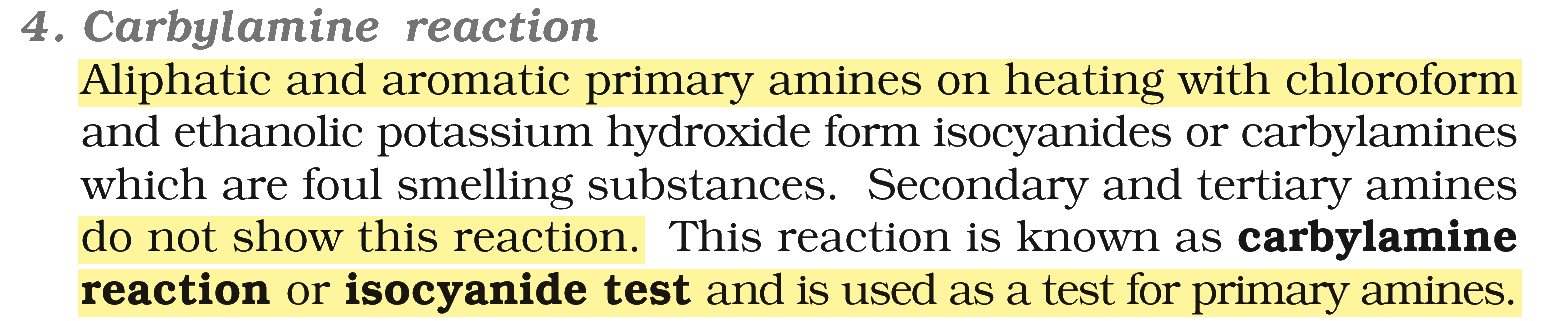
When a primary amine, aliphatic or aromatic, is warmed with chloroform and ethanolic potassium hydroxide, it forms an isocyanide (carbylamine), which has a very unpleasant smell. The two hydrogen atoms on nitrogen are both removed, and the nitrogen becomes bonded to carbon as –N≡C:
\( \displaystyle \ce{R-NH2 + CHCl3 + 3KOH -> R-NC + 3KCl + 3H2O} \)
(A) carbylamine reaction. — Correct. The product R–NC is also called a carbylamine, so the reaction is known as the carbylamine reaction.
(B) isocyanide test. — Correct. The product is an isocyanide, detected by its foul smell, so the same reaction is also called the isocyanide test.
(C) used as a test for primary amines. — Correct. Only an –\( \ce{NH2} \) group has the two hydrogen atoms that must be lost to form –N≡C, so a positive result shows a primary amine.
(D) used as a test for secondary amines. — Incorrect. A secondary amine (\( \ce{R2NH} \)) has only one hydrogen on nitrogen and cannot form an isocyanide. Secondary and tertiary amines give no smell in this test.
NCERT (2026-27 edition):
Carbylamine Reaction